RIP Old VC Playbook: How Investors Are Changing AI Startups Evaluation

Originally published in Forbes

The AI revolution is moving so much faster than previous technological shifts. While the mobile internet took nearly a decade to reach 90 percent household adoption, ChatGPT achieved the same user penetration in just two years. This accelerated cycle is creating companies that reach incredible scale in record time, but it’s also rewriting the venture capital playbook. The traditional rules of SaaS investing are being challenged, and the moats we once relied on are becoming less defensible. Based on recent discussions my Eight Roads Ventures colleague, Michael Treskow, and I have had with our team, here are ten ways investors are changing how they evaluate AI startups today.

1. Agents Are the Future — Not Just Co-Pilots

The first wave of AI applications was dominated by “co-pilots” — tools that assist humans. The next, more powerful wave is characterized by “agents” — autonomous systems that complete tasks from beginning to end. These agents are transforming traditional “systems of record” into “systems of action.” As an investor, the key question goes beyond the earlier paradigm of “does this make a workflow more efficient?” Now, investors must ask, “can this automate the workflow entirely?” How (and to what degree) humans are involved will depend on the AI-use-case fit, enterprise risk appetite, and the existing workflow. As an example, Roo Code has multiple modes, from code mode to architect mode, based on customers’ specific needs. Early breakouts are already emerging in specialized fields like cybersecurity (penetration testing agents), DevOps (debugging agents), and financial services (memo generation agents), showing the power of vertical agents.

2. Traditional SaaS Moats are Diminishing

The three defensive moats that defined the SaaS era are eroding:

Implementation Friction: In the past, the high cost and complexity of implementing enterprise software, especially in regulated industries, created stickiness. Today, AI agents can write code and automate implementation, drastically lowering switching costs.

Workflow stickiness: SaaS used to be the system of record, deeply embedded in the enterprise workflow. But now that agents are performing the workflow entirely, it could reduce the friction of migrating.

Data Gravity: The effort of migrating data from one system to another created a powerful lock-in. Now, AI models can automatically ingest and structure data from various sources (including emails, calendars, and documents) making it far easier to populate a new system, and thereby reducing the stickiness of the incumbent.

3. Enterprise Knowledge, Trust, and Observability Are the New Defensibility

With the underlying models increasingly turning into an API-accessible commodity, differentiation is shifting up the stack to the application layer. The most defensible companies are building new moats around enterprise knowledge, trust, and observability.

When considering workflow integration, investors must figure out how deeply the product is embedded within a customer’s core business processes, or how well the agents internalize the enterprise knowledge if there is forward-deployed engineering. Just like a service provider, the more an agent has absorbed the enterprise’s organizational and operational intricacies and preferences, the harder it is to replace. The second moat, centered on becoming a trusted, default partner, is related to an older sales and marketing principle: In a confusing market, enterprises are looking for a trusted guide to shape their AI strategy. The first vendor to gain a customer’s trust and become their “default” AI partner gains an immense advantage, with the ability to expand across the organization.

The low barrier to entry means that for any given problem, a dozen well-funded players can emerge almost overnight. This has made product-market fit (PMF) a potentially transient advantage. A company might find a temporary fit and grow to a few million in ARR, only to be outflanked by a competitor with a new feature or a slight improvement in the model. As an investor, you must constantly ask: is this PMF durable?

5. The “Incumbents Are Slow” Argument Is No Longer a Given

Two ideas — that incumbents will be slow to act and that customers building in-house solutions will fail — that once formed foundational pillars of venture investing have now been turned on their head.

Incumbents now have access to the same powerful APIs as startups. And while cultural inertia at enterprises remains a challenge, the technical barrier to entry has been lowered, and the proprietary data they have accumulated over the years will give them a head start. Similarly, with modern orchestration tools like Thread, Onyx, or n8n, it’s becoming more feasible for customers to build their own bespoke AI agents in-house. A startup’s competition is no longer just other startups, but also its own customers and the very incumbents it aims to disrupt.

6. TAM May Increase, but Advantages Become Less Obvious Once Pricing Normalizes

A critical shift in the AI era is the expansion of the total addressable market (TAM) beyond traditional software budgets. AI companies can now tap into two distinct enterprise spending pools. “Co-pilot” models, which assist human users, are typically sold on a per-seat basis and compete for existing software budgets. Autonomous “agent” models complete workflows end-to-end, are sold on a per-outcome basis, and hold more transformative potential.

AI agents are positioned to capture a share of the much larger services budget, effectively replacing costs previously allocated to human labor or outsourced services. However, while the opportunity to capture the services budget is immense, it is not a blank check. As some founders have noted, many are generating eight-figure savings while charging customers six-figure prices. As agent-based solutions become more common, the price for automated labor will inevitably face downward pressure and normalize, meaning the initial advantage of charging rates comparable to human labor may not be sustainable long-term.

7. Team Composition Looks Different at AI Companies

AI-native companies are operating with unprecedented efficiency. While a company like Cursor can have great PLG motion and reach $100M ARR with around 30 employees, most enterprise AI companies build a GTM team to reach scale. In a confusing market with intense competition where perceived product differentiation is limited, GTM makes all the difference. On the tech side, CTOs with an ML background will be more essential in the foundational model and middleware layer than in the application layer. Having a Head of AI to stay on top of the latest feature releases and skate to the right opportunity will create a nice complement as the CTO scales the technical organization and infrastructure.

8. SaaS Metrics Still Matter, but in a Different Way

LTV/CAC is still relevant, but velocity matters more. The “Triple, Triple, Double, Double, Double” (T2D3) growth model for top-tier SaaS is being replaced by an even more aggressive trajectory. Some have suggested the new top-quartile metric is “Quintuple, Quadruple, Triple.” For example, a company would grow from $1M to $5M, $5M to $20M, and $20M to $60M over three years. While this velocity is exciting, it can also be misleading. Rapid adoption in a hot market doesn’t guarantee a large TAM or durable revenue. While there is no public benchmark for churn metrics for AI companies yet, we know some of enterprise AI companies’ net revenue retention (NRR) at month 12 is well above 100 percent to compensate for the logo churns — see Glean at 120 percent, Writer at 160 percent, and Jasper for enterprise at 163 percent.

9. Scrutinize Gross Margins and Unit Economics

AI companies often have high compute and model inference costs. While we see margins improve over time, investors must be vigilant about how costs are reported. As others have noted, companies may claim impressive gross margins even though a closer look at their P&L reveals millions in API calls and compute costs categorized under R&D. When re-categorized correctly, their margin was actually negative. Investors must always dig into the P&L to understand the true cost of goods sold.

10. Customer Love Doesn’t Guarantee Retention. Product Usage Is The True PMF

In a normal market, a high net promoter score (NPS) is a strong signal of future retention, but not necessarily in the current AI landscape. Customers may unanimously love a product today, but the market is evolving so quickly that a better alternative may appear in six months. Many enterprises are intentionally building flexibility into their tech stacks to easily swap vendors, so founders and investors alike should beware of “vibe revenue.” Therefore, look beyond NPS to metrics like product usage, which is a leading indicator of retention. Beware of “stealth churn,” where customers who are still paying see less frequent usage, or use a product for a lower percentage of their entire workflow.
dataplor

dataplor provides point-of-interest (POI) data for businesses across the economy for geospatial analyses, operational workflows, and growth initiatives. The company’s data service is refreshed regularly with rigorous quality checks, and goes far beyond basic business names and addresses, enriching each location with brand, transaction, persona, foot-traffic estimates, hours of operation, sentiment scores, popularity metrics, and more, providing an unmatched combination of depth, breadth, and global coverage.

LeadIQ

LeadIQ is a workflow centric lead data and sales prospecting SaaS platform focused on enterprise and mid-market clients. LeadIQ allows users to research and capture potential leads easily, enrich leads with further details, and integrates into various sales acceleration and customer management platforms like Salesloft, Outreach, Hubspot and Salesforce.


An Eight Roads investment. Eight Roads is F-Prime’s sister venture capital investment group, with which F-Prime collaborates on investments outside of the Americas and Europe.

* Denotes activity with the non-F-Prime investment team.

Roark

Roark automates the creation of voice agent test suites from real customer journeys and AI-driven edge-case predictions, so businesses can validate every path before deployment and ship reliable voice AI faster.

Myolab

Myolab builds personalized human digital twins with embodied intelligence to accurately predict an individual’s physiology, cognition, and behavior, and enable hyper-personalized experiences in health, search, and e-commerce.

dataplor: The Gold Standard in Location Intelligence

Whether you are building an autonomous delivery robot, identifying the best-performing Zara in the Netherlands, or comparing visits to Starbucks versus Dunkin’ Donuts in Boston’s Back Bay, actionable insights hinge on clean, highly accurate, up-to-date point of interest (POI) data. Across so many sectors, these insights underpin expansion plans, demand forecasting, customer targeting, underwriting, partnerships and more.

And yet, high-quality location data remains elusive. Historically, only large enterprises had the resources to acquire and leverage location data in their strategic decision-making processes, often stitching together multiple sources, or paying consultants or outsourced clipboard armies to collect data on the ground. Even then, coverage gaps and stale information were common. Maintaining your own POI data is expensive, painstaking work that requires perpetual aggregation, validation, and enrichment, making it a great candidate for outsourcing.

However, none of the POI players that emerged have come armed with a truly comprehensive set of high quality, global location data — until now. Since meeting Geoff Michener and the dataplor team in 2023, we’ve been impressed by their relentless focus on delivering clean, reliable POI data across more than 250 countries and territories. dataplor’s solution is mission critical to Global 2000 companies in tech, consumer goods, logistics, retail, F&B, and finance for geospatial analyses, operational workflows, and growth initiatives. The company’s data service is refreshed regularly with rigorous quality checks, and goes far beyond basic business names and addresses, enriching each location with brand, transaction, persona, foot-traffic estimates, hours of operation, sentiment scores, popularity metrics, and more. It truly is an unmatched combination of depth, breadth, and global coverage.

At F-Prime, our investments in data platforms like Lighthouse, Quovo, 1uphealth, and Canoe have reinforced our conviction that outsized value is created by starting with exceptionally high-quality data. The difference between 95 percent and 99.9 percent accuracy is massive and consequential for discerning customers. dataplor is democratizing access to highly accurate, actionable POI data, empowering organizations to make better-informed decisions and personalize customer experiences at scale. With the team’s exciting vision and roadmap, we are honored to partner with Geoff, Ryan, and the rest of the dataplor team on their $20.5M Series B.

Cartesian Kinetics

Cartesian Kinetics provides fast, retrofittable, Goods to Person automation solutions using its proprietary platform Carte+. Carte+ enables efficient and reliable order fulfillment to cope with increasingly on-demand consumption patterns. Cartesian Kinetics is headquartered in the US and has teams across multiple locations in the US and Bangalore, India.

2025 State of Robotics Report

We’re incredibly excited to share our 2025 update to our annual State of Robotics report. The report is a comprehensive analysis of more than 1,500 robotics companies globally, including a company-by-company exploration of the use case each is pursuing.

We invite you to download the report here, and reach out to authors Sanjay Aggarwal and Betsy Mulé.


Data in VC, Part 3: Looking to the Future

In my last two stories about how venture capitalists are using AI, we discussed how investors are currently leveraging data science to help source and make decisions about potential investments, including why VCs have been slow to adopt AI. We also explored the results of a survey that highlighted how, where, and why data scientists on VC teams are using AI, and what effect it’s having on the work of the firms they work at.

Given this work, I’d like to close out this series with a short overview of three potential futures we see for AI in VC, each with vastly different outcomes for the industry.


Future #1: Leveraging data will create a sustainable competitive advantage

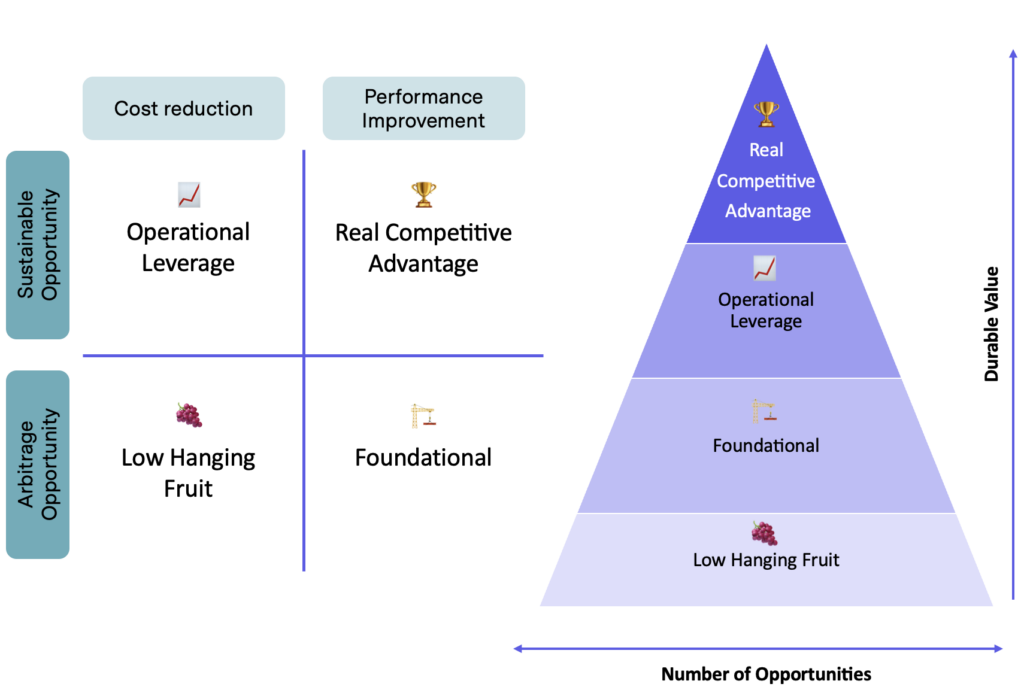
In this scenario, we assume that it is genuinely possible to find real competitive advantage over other firms using AI. Firms who see the biggest advantage will identify narrow areas in which to use AI to directly impact their differentiation from others. To identify those areas, recall our four-tier framework to help categorize the different types of opportunity AI poses to venture firms:

In this scenario, any firm that invests in the upper two quadrants will be able to build or sustain a competitive advantage over its peers. As a reminder, here are some examples of efforts that fall under those categories:

Operational Leverage: Aggregating and synthesizing data for easier company analysis, automating data entry, consolidating relationship data for more informed outreach, synthesizing portfolio health report.

Real Competitive Advantage: Creating predictive models for niche investment themes, algorithmically finding ways to expand networks, automating insights extraction from diligence documents, identifying emerging trends faster than competitors.

It’s worth noting that the lower two quadrants, which cover everything from email automation and common data vendors (low-hanging fruit) through CRM and network mapping (foundational) will be table stakes in the near-to-medium term.

Regardless of which future we find ourselves in, efforts that offer operational and competitive leverage should be the most important pieces of a VC data scientist’s job. In this specific future, the list of tasks above could be mixed, matched, and tailored to a fund’s specific strategy, making them less generalizable but highly valuable when aligned with a firm’s unique strengths.

VCs have a lot of different directions to take their automation and data efforts but under this scenario, firms that fail to make strides in those two categories will also fail to gain a competitive advantage. Right now, our industry is focusing too much on the “low-hanging fruit” opportunities, which would explain why our survey showed that firms are not seeing a lot of tangible impact from AI at the moment. The takeaway here is that firms should be bold and make strategic bets in AI — and do so sooner than later because, as we’ll see in our next hypothesis, timing will likely be important.


Future #2: In the short term, there will be an advantage for first movers

As we’ve discussed, there is a lot of friction in VCs’ work processes, and AI offers a unique chance to remove a lot of it. However, under this scenario, the ability to autonomously aggregate and synthesize company data for analysis, automate data entry, and other “operational” opportunities will become commoditized over time. As a result, the only real advantage will go to the VC firms whose data scientists move first.

This scenario assumes that there is no durable, long-term differentiation to be found for firms that invest in AI efforts, even those we categorized as “real competitive advantage.” The only advantages will play out over the short term, and will only flow to those who invest early and move fast. The advantage will be short-lived, however, as best practices spread through the industry and those efforts become commoditized.


Future #3: All AI efforts in VC will become commoditized

This hypothesis is simple: all potential applications of AI in VC will be relatively easy and quick to implement, and will offer no durable advantage over others. In this scenario, the only “losers” will be firms that fail to invest in AI at all.

If you believe in this outcome, you believe that all tooling that VCs can build for themselves will be based on similar systems and ideas, and there will be a low ceiling on how creative industry players can get with them. The result would be a race to the bottom, where everyone builds similar tooling with few competitive rewards on offer beyond mere survival. The result will be a VC landscape similar to the one we currently live in, where there will be little to differentiate funds other than brand and fund size — capital remains capital, regardless of who’s handing it over.

Regardless of how the future of data in VC plays out, the truth underlying all these realities is that data (and specifically data science) is going to play a role in the future of our industry. The degree of the potential advantage will vary widely for those who invest, but the main losers will be those funds that don’t incorporate data and AI into their workflows at all.