Lighthouse (formerly OTA Insight) is the leading commercial platform for the travel & hospitality industry. We transform complexity into confidence by providing actionable market insights, business intelligence, and pricing tools that maximize revenue growth. We continually innovate to deliver the best platform for hospitality professionals to price more effectively, measure performance more efficiently, and understand the market in new ways. Trusted by over 65,000 hotels in 185 countries, Lighthouse is the only solution that provides real-time hotel and short-term rental data in a single platform. We strive to deliver the best possible experience with unmatched customer service. We consider our clients as true partners—their success is our success.
Sector: Technology
Threat Stack
Threat Stack enables growth-driven companies to scale securely and meet complex cloud security needs by identifying and verifying insider threats, external attacks, and data loss in real time. With a comprehensive approach to intrusion detection, Threat Stack empowers security and operations to better manage risk and compliance across their entire infrastructure, including cloud, hybrid cloud, multi-cloud, and containerized environments. Threat Stack was acquired by F5 Networks in 2021.
Optimus Ride
The unique makeup of the Optimus Ride team includes over 30 years of shared experience on the cutting edge of interdisciplinary research in self-driving technologies, electric vehicles, mobility-on-demand and other transportation systems. The team also has a decade of industrial and entrepreneurial experience spanning manufacturing robots, medical robots, shared vehicle fleet management and urban design. Building on this significant knowledge, the company will continue to leverage the latest advances in complex sensor fusion, mapping, computer vision and machine learning to ultimately deploy a new form of transportation system that enables safe, sustainable and equitable mobility access. This company was acquired by Magna in 2022.
John Vigeant
John Vigeant is a Venture Partner with F-Prime and a recognized leader in the devops and security communities. John is VP, Americas for ObserveIT, the world’s #1 Insider Threat Management Solution. Previously John was CEO of Reddo Mobility, a code-less provider of enterprise mobility solutions for large enterprises and CEO of Tracelytics (acquired by AppNeta), a SaaS-based application performance management (APM) solution that provides deep visibility into the performance of distributed Web applications.
Earlier in his career, John led business development for XenSource until its acquisition by Citrix for $500M. John continued with Citrix until 2011 when he joined Reddo Mobility. John serves as an advisor to many early stage technology companies and is a valued resource to our portfolio companies on product strategy and operations.
Artemis Health
Artemis Health helps companies utilize their data to optimize their benefits programs while minimizing their spend. The Artemis Platform provides customers with actionable data on their benefits programs, opportunities and gaps, and easy-to-use tools to help them make great decisions. Artemis Health was acquired by Nomi Health in 2022.
Buoy Health
Buoy is an online symptom and cure checker that uses an intelligent algorithm backed by medical data to diagnose patients.
Protenus
The Protenus healthcare compliance analytics platform uses artificial intelligence to help partner hospitals make decisions about how to better protect their data, their patients, and their institutions. This company was acquired by Bluesight in 2025.
RiskRecon
RiskRecon is the only continuous vendor monitoring solution that delivers risk-prioritized action plans custom-tuned to match your risk priorities, providing the world’s easiest path to understanding and acting on third-party cyber risk. Partner with RiskRecon to build your scalable, third-party risk management program to realize dramatically better risk outcomes. RiskRecon was acquired by Mastercard in 2019.
Quovo
Quovo is a data platform providing connectivity to consumer financial accounts. Quovo centralizes, organizes, and enriches data from millions of accounts across more than 14,000 institutions to provide businesses with a comprehensive picture of each customers’ financial identity. With industry-specific solutions, clients from emerging fintech startups to Fortune 500 companies rely on Quovo for its seamless technology and rich data insights to deliver more personalized and frictionless customer experiences. Quovo’s unparalleled coverage of the financial ecosystem, powerful data analytics, and flexible deployment options propel businesses in uncovering opportunities to grow their relationships with customers. Quovo was acquired by Plaid in 2019.
Where Are They Now — Exploring Boston’s Iconic Startup Stories. Introducing Founders Diaries.
Do you remember VH1’s hit TV series Where Are They Now? It was kind of addicting. Each episode would chronicle the journey of a celebrity who had achieved greatness in the past, yet was no longer in the public eye. Well recently, that’s what we’re thinking about in our office at F-Prime.
Like many of you, we think a lot about the entrepreneurs who built iconic companies in Boston; such as, Mitch Kapor, co-founder of Lotus Development Corp, the forerunner to Microsoft Excel, and Amos Hostetter, co-founder of Continental Cablevision (one of our early investments). These entrepreneurs paved the way for many of us and built the foundation of today’s fertile entrepreneurial ecosystem in Boston.
We decided to do some research.
And long before the PayPal Mafia became famous, these Boston founders inspired their own future generation of entrepreneurs. Take Akamai — we lost count at 39, for the number of companies started by its alumni. Employees of Steve Papa’s Endeca (acquired by Oracle in 2011 for $1.0B) are just beginning to fan out and start new companies — 10 and counting.
But while we know where Mitch Kapor is most weeks — backing entrepreneurs making a social impact (and a co-investor of ours in FutureAdvisor) — we had no idea where Drs. James and Janet Baker were, Co-Founders of Dragon Systems, and pioneers in speech recognition.
What followed was a wonderful journey of our own. We analyzed the hard numbers — what are Boston’s biggest startup successes — and we delved into the soft stories of founders — how did they achieve such success? We even pieced together the web of startups formed by alumni of these Boston success stories.
The more we went down the rabbit hole, the more we thought other Bostonians would enjoy this as much as we do, so we decided to do two things.
For those who like data. We’ll start to share our research on the big startup successes of Boston with an initial post today. And if you enjoy this as much as we do, please help us with our research! Peering into founder journeys is a process of exploration and takes many contributors. We welcome additions and corrections from anyone in the community.
For those who like the stories behind the data: Founders Diaries. We also quickly figured out that listening to iconic founders tell their stories is a privilege. The tribal knowledge they share is a gift. We started inviting other entrepreneurs to join us and finally made it a regular event open to Boston’s startup community. It’s called Founders Diaries and we hope it will serve as an intimate forum for the current generation of Boston founders to hear the stories of Boston’s most iconic startups. It’s been a joy so far. A big thanks to Robin Chase, Founder of Zipcar, and Jeff Glass, Founder of m-Qube, for joining us at our last two events. We look forward to welcoming Mark McWeeny, founder of Rue La La and Michael Simon, founder of LogMeIn, who will share their stories at events in April and May (click on the links to request an invite).
So, on to some fun findings on Boston startup successes.
Boston’s Greatest Hits
There has been good research from folks like Jeff Bussgang on the current crop of Unicorns and Reindeers, so we looked back over the last 25 years for startups that built companies worth at least $400M (“Large Exits”).[1] Most achieved that valuation at exit (IPO or M&A), but some got there after going public — don’t you wish you had bought LogMeIn in 2009 when it IPO’d at $340M. It’s added $2.2B organically since then, and now sits at a $5.0B market cap following the recent merger with GoTo.
TL;DR Boston entrepreneurs rock!
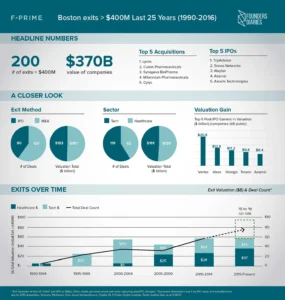
200 startups with Large Exits producing $370B in total valuation. 60% were by M&A; 40% by IPO. The median exit valuation is $668M and the median valuation of the 66 surviving standalone companies is $1,318M. Check out the table below, but these points standout:
Boston keeps getting better. Exits among venture-backed startups tend to be cyclical, but Boston has generally produced more Large Exits — by number and value — every five years. From 71 startups and $157B value during the 15 years before 2005 to 129 startups and $213B value in the 11 years after 2005.
The rise of healthcare. For a long time tech startups accounted for the large majority of exits in Boston — 82% of all Large Exits were tech from 1990–2004; however, that is quickly changing. Since 2005, healthcare exits have been 53% of Large Exits (including several companies from our portfolio such as Blueprint Medicines, Ironwood Pharmaceuticals and FoldRX). It’s clear to anyone living in Boston that our city has become a world leader in healthcare.
Great companies do not stop with the “Exit.” ~30% of our Large Exits (66) are still public and operating as standalone companies, generating an additional $133B in net value since IPO. Not surprisingly 10 of them account for 65% of the value increase and the winner by far is Vertex (+$20.8B). Other top 10 include: Tesaro (+$9.8B), Akamai (+$8.4B), and Nuance (+$4.5B). And yes, we use ‘net value’ because some startups did suffer post-IPO, but it was nice to see 53 startups rise in value while only 13 fell.
Building big businesses takes time. Co-founders who were there ‘day one’ appreciate just how long it takes to build a big business. On the outside, success can look so easy and sudden! One of the things that has not changed in Boston is that it takes years of hard work to achieve a Large Exit. From 1995–1999 it took eight years on average from founding to exit and it took 13 years from 2010–2014. 12 years is the average over the last 25 years.
Say what you want, but Boston is not a Consumer tech town…yet. Of the 200 Large Exits over the last 25 years, only 13 (7%) were consumer focused. We defined that generously too, counting Nuance and Monster as consumer even though they derive significant revenue from business customers. On the positive side, 9 of the 13 Large Exits were in the last 10 years and Boston definitely rocks in online travel producing both TripAdvisor (TRIP) and Kayak (acquired by Priceline).
Success has many fathers…and many children too.
We started our research to learn more about the founders of these iconic Boston startups, but we came away equally intrigued by the alumni. Alumni say a lot about the founders themselves — the culture, support and inspiration they provided to their employees. The more we looked at this, the more we appreciated how much it said about the strength of the Boston ecosystem too.
For now, we’ll share our first pass at 10 startups that we were curious about — no particular prioritization other than our personal interest. You may be as surprised as we were. Akamai alumni have co-founded 39 startups! Nearly 30 each for Vertex and RSA Security. And check out Hubspot. Just two years after exit and already 25 alumni-founded startups. On future posts we will look at more of these alumni networks — it’s really fun to piece it all together. You should try it. No, really, we could use your help! We must be missing some and were wrong about others. We would love your help filling in the gaps.
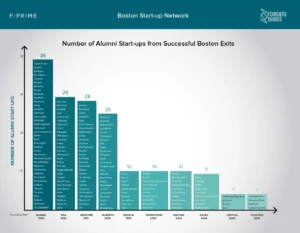
And we will definitely look at the alumni of Rue La La and LogMeIn before our upcoming Founders Diaries event and welcome any contributions in advance. Please comment below or send us an email. And of course, we invite you to join us as well. Mark McWeeny, founder of Rue La La will speak on April 19th ( request invite here) and Michael Simon, founder of LogMeIn (NASDAQ: LOGM) will speak on May 18th ( request invite here). Both Rue La La and LogMeIn are extraordinary companies, with unique founders, journeys and outcomes. We hope you can join us.
[1] Sadly we excluded the hidden gems that have stayed private like Bose (estimated $3.5B revenue), Intex (THE financial modeling platform in asset-backed securities), and Bain and The Boston Consulting Group.
Originally published at https://www.linkedin.com on March 28, 2017.