E-Commerce Divergence & the Neobank Conundrum

The Fintech Index in Q2: Cautious Optimism Despite e-Commerce Divergence

Let’s dive in.

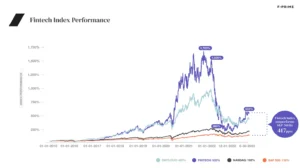
Headline: The Fintech Index was up 21% in Q2 (+69.2% YTD), from 423% at the end of Q1 to 533% at the end of Q2. Overall, the Fintech Index outperformed other indexes we’re tracking: the Emerging Cloud Index was up ~10%, Nasdaq grew ~13%, and the S&P 500 climbed ~8%.

The Fintech Index regained almost $40B in market cap in Q2 with the median market cap increasing from $2.5B to $2.8B. As we would expect from larger companies, especially amid a turbulent macro environment, the average LTM growth rate for Fintech Index companies continued to decelerate, falling from 48% (Q4) to 35% (Q1) to 28% (Q2).

A Tale of Two E-Commerce Platforms: There was one company that drove the index’s gains this quarter: Shopify. The company makes up ~16% of the Index and was up 35% in Q2. Shopify’s rebound primarily took place during the first week of May, when the company announced surprisingly robust first-quarter results along with its decision to abandon its logistics aspirations via a Flexport partnership. The e-commerce giant increased GMV by 15%, raised its subscription plans by an average 33%, and cut its workforce by 20%.

Conversely, MercadoLibre, Latin America’s largest e-commerce platform was the biggest drag on the Index this quarter, after a strong Q1. The stock makes up ~12% of the Index and was down 10% in Q2. While the company is still growing at an attractive clip (~30% YoY), its fintech business is decelerating. The fintech segment historically grew by 100%+ QoQ but grew by 64% in Q1 2023 (after posting 93% growth in Q4 2022). This deceleration weighed on public investors’ minds in Q2.


Source: Fintech Index


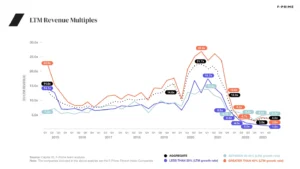
Multiples: The public markets continue to value goldilocks performance: solid growth with capital efficiency. Companies growing 20-40% traded at a higher 5.7x EV/Revenue multiple than companies growing faster than 40%, which were valued at 3.9x EV/Revenue. Overall, the broader Fintech Index continues to trade below historical averages, though there are notable outliers like Shopify (13.4x), Xero (13.3x), Bill.com (12.3x), and Flywire (9.6x).

By industry: Fintech B2B SaaS, lending, and wealth & asset management companies saw modest increases in multiples over the past quarter.

  • Fast-growing fintech B2B SaaS companies such as Bill.com and Xero have a 12.8x multiple. However, that’s still a significant decline from the 50x multiple that companies in this category enjoyed at the market’s peak in Q3 2021.
  • Fast-growing lenders like Affirm have nearly doubled their revenue multiples over the past 6 months to ~6x.
  • Similar to high-growth lenders, growing wealth & asset management companies like Coinbase have seen their revenue multiples almost double over the past six months as well, currently trading ~5x.
  • Check out the Fintech Index website to explore multiples for each sector and growth rate.

Index removals: While M&A and acqui-hires are ramping up, none of the Fintech Index companies were acquired this quarter. However, Dave no longer met our criteria and was removed from the Index. More on that below.

Index Additions: None

Fundraising: North American fintech startups raised a total of $2.7B in Q2, pretty much on par with Q1 if you exclude that massive Stripe deal.


Consumers Still Like Neobanks. Public Investors, Not So Much

Despite continued revenue growth, a march towards profitability, and stable unit economics, neobank valuations continued to decline. We removed Dave from the Fintech Index because it failed to meet our market cap and liquidity criteria.

Dave has maintained strong growth for both revenue (37% YoY growth) and membership (27% YoY). The company’s credit metrics have also demonstrated consistent stability, with notable improvements in unit economics. Customer acquisition cost decreased 39% (YoY), from $26 to $16 while ARPU grew from $121 to $124. Credit metrics also showed overall stability, with Q2 net charge-offs ~10bps lower YoY at 2.4%, and the 28-day delinquency rate 67bps lower YoY at 2.6%

More broadly, neobanks continue to gain market share against incumbent banks, accounting for 47% of new checking accounts opened (2023 YTD) up from 36% in 2020. The share held by megabanks (>$1T in assets) fell from 24% to 17% over the same time period.

Nonetheless, public investors have reservations about the neobank model. By the end of the quarter, Dave’s enterprise value ($47M) had dropped 98% since its public listing in January 2022. In order to avoid delisting from stock exchanges, Dave and other neobanks conducted reverse-stock splits to exceed the NYSE minimum of $1. However, despite these efforts, share prices continued to decline. Public investors remained concerned with:

  • Credit Cycle: Dave successfully built a model to serve lower-to-middle income consumers who were previously underserved by major banks; however, in a negative credit cycle investors are especially apprehensive about the potential impact on Dave’s customer base. A downturn in the economy or a rise in credit defaults could significantly affect the company’s profitability
  • Customer Base: Dave’s younger customer base has lower spending capacity and also raises concerns about the bank’s ability to grow ARPU
  • Low absolute unit economics: While Dave’s unit economics work, with such low absolute dollars per customer, Dave requires high growth and new customer acquisition to achieve profit scale. In a cycle where capital is expensive, Dave’s growth model is constrained.

It’s unclear if neobanks can outlast the current macro cycle or become cash flow positive to control their destiny, but we believe that in the fullness of time — and potentially in the hands of a larger balance sheet — the neobanks will play an important role in banking. We will track this segment closely over the coming quarters.


Written with Zoey Tang.

Stephanie Robotham

Stephanie is a Venture Partner at F-Prime, advising portfolio companies in the USA, Europe, and India on their GTM strategies for sales, marketing, and customer success. She is also currently a Value Accelerator Operating Advisor at Goldman Sachs Asset Management, and previously held roles at Salesforce, Cordial Inc., Iterable, and Optimizely. Prior to her current roles, she was CMO at Gainsight where she successfully re-structured the Marketing and Business Development organizations ahead of the company’s $1.1bn exit in 2020, gaining valuable M&A experience along the way.

Stephanie brings more than 30 years of experience building and advising impactful and customer-centric sales and marketing teams at high-growth SaaS companies. She understands growth stage, scale-up, and established public company structure and culture, with knowledge of scaling companies from $3M ARR to more than $300M.

Stephanie is a graduate of the University of Northumberland, where she received a degree in Marketing (Hons).

Henry Trapnell

Henry Trapnell joined F-Prime as a Director of Industry Networks to support the firm’s Tech Fund in the U.S. and Eight Roads Ventures abroad. He is a strong believer in the power of community to fuel business growth, and loves connecting portfolio company founders with corporate leaders to build symbiotic partnerships.

Prior to F-Prime, he helped lead digital go-to-market strategy at Google for the company’s hardware & services. He previously advised corporate executives on behalf of J.P. Morgan, where he developed a nuanced understanding of the intersection between emerging technologies, finance, and personal relationships.

Henry graduated from the Stanford Graduate School of Business and studied Economics and Chinese at Boston University. He also serves on the board of the Chestnut Hill Community Association in Philadelphia.

Key Takeaways from Robotics Invest 2023

Sanjay Aggarwal reflects on our inaugural Robotics Invest summit

Co-authored with Fady Saad of Cybernetix Ventures

The ideas outlined below come from the panelists, as summarized by our team taking notes on the day. To stay in touch, follow Robotics invest on LinkedIn and Twitter

Last week, we welcomed some of the robotics industry’s leading entrepreneurs, investors, and operators to Boston for Robotics Invest, an invite-only summit packed with keynotes, panels, case studies, and robot demos.

We were very intentional in curating the speakers in these panels and, judging from the overwhelming response in the room, these discussions delivered. We’re extremely grateful to all our panelists for sharing their wisdom and experience with the group.

While the event itself was oversubscribed, we wanted to make sure everyone had the chance to access the insight, experience, and tactical advice that was available throughout the day. Luckily, our team was on hand to take notes. Here, we’ve summarized the key takeaways from each Robotics Invest panel conversation.


Robotics as an Investment Class

robotics as an asset class

– Robotics sits in between two ends of the spectrum in the investing community: SaaS and biotech. This means that investors might look at robotics companies with a lens that may not fit, and try to optimize for metrics or markers for success that aren’t relevant for this category.

– Likewise, robotics companies often don’t follow the typical growth trend of your average SaaS business. For example, Kiva Systems spent three-to-four years with flat growth before it really took off.

– We are still in the early days of robotics investment, especially when compared to the SaaS sector. The labor shortage is a secular issue, and the economy requires automation to keep up GDP growth.

– A solution’s lifetime value is an important metric in robotics, after factoring in capital and operational costs. Only looking at year-by-year margins may tell the wrong story.

– We are starting to see an evolution in financing models, which includes availability of equipment financing, which is helping to mitigate the capital costs of hardware.

– Revenue benchmarks aren’t as important for robotics companies at the Series A stage, nor is LTV/CAC. Instead, investors are looking for evidence that customers are moving beyond initial pilots and deploying the systems in production and at scale.


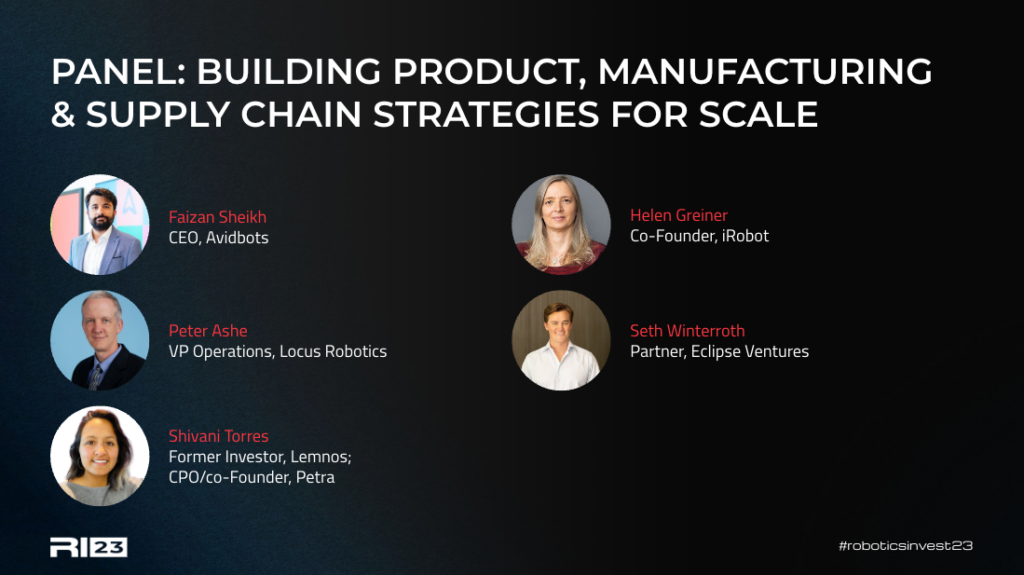
Building Product, Manufacturing & Supply Chain Strategies for Scale
building robotics companies for scale

– To succeed, robotics companies need to build great applications at the right time. For example, companies had tried to build cleaning robots in the 1990’s but the timing wasn’t right. And while matching macro conditions to the tech and value proposition is key, robotics companies should not let perfection trump a solution that’s “good enough.”

– Your first two hires should be a subject matter expert who can build the technology, and a subject matter expert who deeply understands the problem. Your first sales hire should be able to roll with the inevitable bugs and customer success issues, and be willing to go on this journey with you.

– Understand your technology’s core competency and be able to do that in-house. Everything else is an opportunity to outsource. However, you need to be careful about which tier of contract manufacturer you go with — if you don’t have a level of mind share with them, it can be hard to maintain the quality of your end product.

– Identify what’s essential and build it — over-engineering solutions is a common issue that can lead to cost escalation. It’s easier to add a feature in the future than take it away to reduce costs.

– There are a number of advantages to a Robotics-as-a-Service model. Reducing the capital intensity of an up-front sale can accelerate deployment, and you get a lot more customer engagement through the RaaS model. When a customer is evaluating your service’s value on a regular basis, you get a certain baseline of customer engagement.


Building a GTM Strategy for Scale

go to market strategy robotics

– Robotics startups should be talking to and incorporating the feedback of customers on day one. The transition to asking for payment can be tough and industry dependent — for example, contractors tend to pay their subcontractors when the job is done, and will not pay up front — so a pilot is usually necessary.

– Sales tend to fall apart when startups overpromise. Your timing needs to be realistic, and you must provide support over the longer term.

– The systems integrators flywheel can take a while to get going, and it’s not right for every use case. Startups at the very early stage should work directly with customers for design iteration. When you’re ready to deploy 10-99 units, a smaller system integrator (SI) can help customize the solution. And when you’re selling 100+, you’re ready for a larger SI like Dematic, Schaefer, or Honeywell.

– Lock-in long lead times on your supply chain early, and then design around them. You also need to be flexible and creative on how you source — for example, second-hand markets can be invaluable. As a general rule, designing around your supply chain up front can solve a lot of problems.

– Not all growth is good growth. The number one thing autonomous mobile robotics companies should work towards is a high number of customer relationships, and how you can expand the profitability for each. In other words, land-and-expand is critical.


Raising Money from Later Stage Investors

– The later stage is less aspirational than the early stage. The early stage is about selling the sizzle — the later stage is about selling the steak.

– Valuation matters, but it’s more important to focus on getting a fair valuation based on a business’ metrics, results, history, team, and other factors, rather than squeezing out the last dollar.

– Presenting realistic numbers is better than presenting spreadsheet projections that don’t make sense. Investors would rather see a credible number than an outsized revenue projection.

– Units matter more than revenue. Having credibility with customers and executing against your commitments matters, because it’s not just one transactional event.

– Investors want to be convinced that they’re investing in a team, not just one person. So showcase the team and let them present and answer questions during diligence.

– Diligence for later-stage investments involves talking to customers and getting conviction from them about whether they will do what the company says they will. Procuring customer references through videos or visits is a scalable solution here.


Role of Corporates in Start Up Innovation Landscape
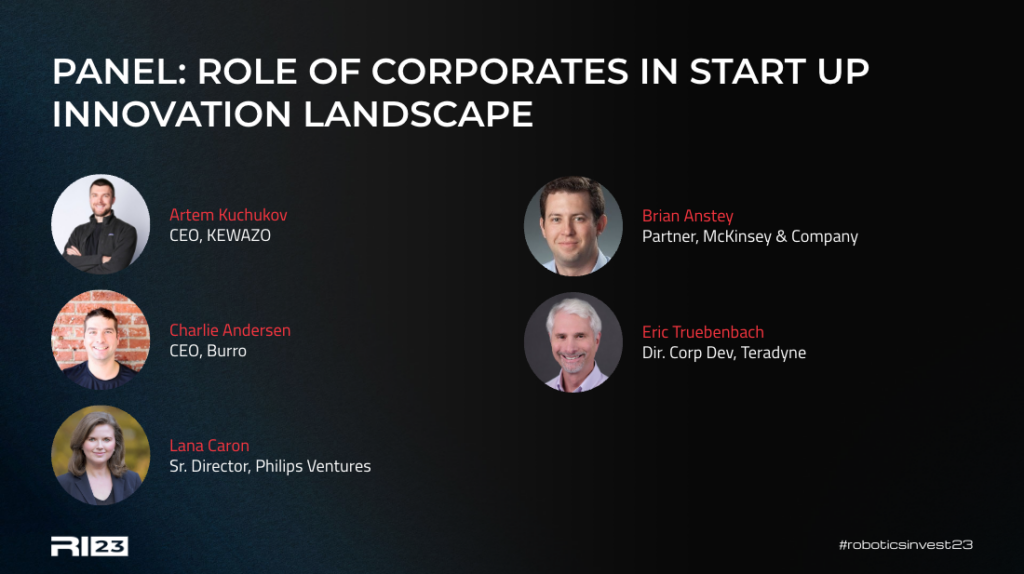
role of corporations in the robotics investment landscape

– Corporates can provide access to markets and distribution networks, and build trust in early-stage companies by putting their weight behind their product and brand. However, startups must clear high risk and benefits bars during the evaluation process to land a potential partnership.

– FOMO does not necessarily enter into the equation, but if there’s a deadline to meet, the team will try to meet it as fast as possible.

– Large corporates have integration teams responsible for combining new technology into the company after mergers or acquisitions, while smaller companies may assign temporary teams for this task.

– To maintain relationships with corporates through different team members and priorities, early-stage companies should focus on key advocates and sponsors while also branching out to other stakeholders within different teams and functions.

– Corporate venture capital investments can offer access to expertise that would otherwise be costly, and accelerate regulatory timelines.

– Manufacturing experts from large corporates can help reduce costs by renegotiating contracts, playing hard ball with suppliers, and identifying alternatives.


Exiting a Robotics Business

exit strategy robotics

– When it comes to exit strategy for startups, good communication channels are key in keeping options open. Founders should be proactive and keep everyone updated quarterly.

– Opinions are mixed on strategic investors. If you get the right partner, it gives your business model some validation. However, you want to limit your involvement with strategics if you have lots of options, as you don’t want to be limited to a single acquirer. Bottom line: either have multiple strategics on your cap table, or zero.

– The lifecycle of a robotics company can be up to 20 years, so plan for the long game.

– Personal relationships between board members and CEOs are more important than anything right now. A good board will have consistent and easy-to-pitch messaging for potential investors.

– The use of robotics is a long term secular trend that will not stop, and is accelerating with broader adoption and understanding of AI and machine learning.


To stay in touch, follow Robotics invest on LinkedIn and Twitter

Albert Invent

Albert Invent is an end-to-end R&D platform for chemists and materials scientists, combining ELN, LIMS, inventory, and regulatory tools in one system. Powered by its AI engine, Breakthrough™, trained on over 15 million molecular structures, Albert enables predictive formulation, inverse design, and faster innovation cycles for the worlds largest chemical companies.

Albert Invent’s $7.5M Seed Round

Modernizing the chemical R&D tech stack

We’re excited to partner on Albert Invent’s $7.5M Seed round!

You’d be surprised how much pen-and-paper is still used in chemical R&D labs nowadays.

The current state of the market involves:
– Low levels of digitization (Excel + paper notebooks)
– Unintegrated tools and machines
– Experiment data loss, leading to repeat experimentation
– No ability to search and share cross-functionally

The solution: 
Albert, which lets R&D teams track chemistry data

Why Albert?
– Co-founders Nick Talken and Ken Kisner have roots in Henkel, a giant in the chemicals industry, which they joined after it acquired their 3D photopolymers manufacturing startup, Molecule, in 2019. Ken grew up in a paint factory and, as he put it to us, has “paint running through his veins”
– Albert’s product is now used by multibillion dollar corporations across multiple regions

Announcing the Travel Tech Titans: Celebrating the Game-Changing Innovators in Travel

Today, we are thrilled to announce the winners of the inaugural Travel Tech Titans, our way of celebrating the game-changing innovators in travel.

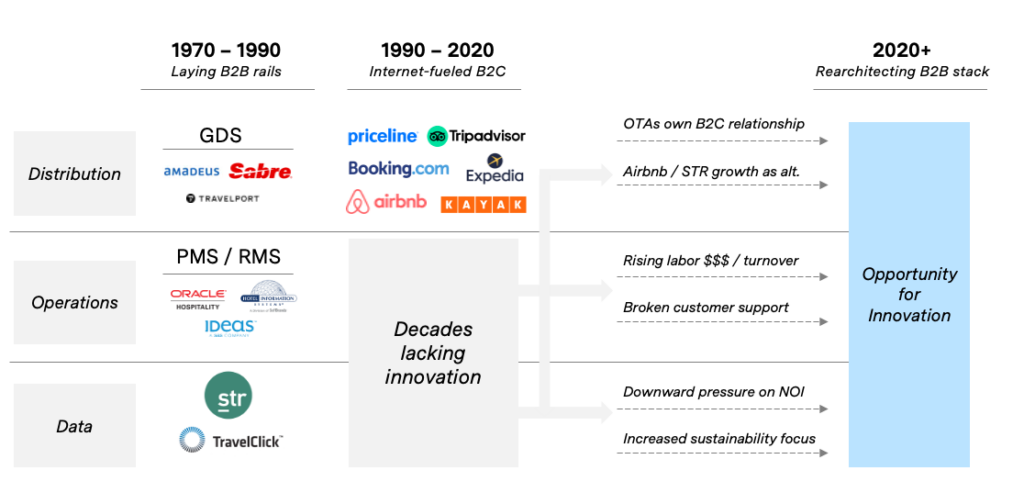
Travel is a keystone industry, representing 10% of global GDP before the pandemic. A small number of dominant giants have long controlled the B2B infrastructure behind travel. The first wave of companies — including Amadeus, Sabre and Oracle — laid the foundation for today’s travel infrastructure. The second wave of innovation brought the industry online and led to significant B2C businesses emerging: Expedia, Booking.com, and even Airbnb. Decades have passed and these Goliaths are firmly entrenched, having weaved an intricate web of multi-decade customer and partner relationships. Today, these dominant players have a combined market value exceeding $150 billion.

core trends in travel tech

However, the industry is now facing new and unprecedented challenges: staff shortages, rising customer expectations, transition to carbon neutral, GenZ’s distinct travel tastes, and big tech trying to enter the distribution game. We believe that startups in the industry have a unique position to help solve these challenges. The pandemic ripped the Band-Aid off the industry’s aging infrastructure and exposed the need for rapid tech innovation and modern customer experiences.

With the tide now turning, we believe it’s crucial to acknowledge and celebrate the startups that are doing amazing work in this industry. These companies are the driving force behind the transformation of travel, and we anticipate that many of them will become the pillars of the industry in the future. With this ambition in mind, we are thrilled to present the inaugural Travel Tech Titans award, an initiative that recognizes and honors these startups’ exceptional contributions to the industry’s future.

Almost 200 nominees represent an impressive cross-section of the travel tech industry, with headquarters in 21 countries and more than 12,000 employees, demonstrating the global nature of the industry. Ranging from bootstrapped to pre-IPO, nominees have cumulatively raised $6.9 billion since founding, and raised 128 funding rounds in the past 18 months alone. In a world where the VC market has slowed, that is an astounding recognition of the tailwinds and interest in travel tech. Interestingly, 70% of the nominated companies are focused on infrastructure and data, addressing the longstanding systemic backend issues in travel.

The Travel Tech Titans’ exceptional judges had the difficult job of diligently studying the ~200 nominees to select the most exciting and impactful companies within the group. We’re pleased to share the winners today:


Early stage winners have raised 0-$10M in funding.

  • BTP AutomationAggregates and analyzes corporate travel hotel data from multiple sources, providing real-time visibility on hotel spend plus an end-to-end and automated RFP.
  • Deal EngineAutomates manual processes currently done by armies of people in the travel industry.
  • Grapevine: First-to-market AI technology that identifies missed retailing opportunities from data and optimizes revenue through intelligent, post-booking remarketing.
  • NeoKe: A self-sovereign identity platform enhancing travel experiences like check-ins and border control by streamlining personal data management, prioritizing privacy, and enabling seamless interactions.
  • NLX: Delivers world-class conversational AI-powered customer experiences that meet the scale, complexity, and compliance standards of enterprise organizations.
  • Thrust Carbon: Analyses multiple data points to provide carbon calculations across the entire travel spectrum, using the ICAO methodology to layer both aircraft model and class into the calculations.


mid stage travel tech titans

Mid-stage winners have raised $10-$50M in funding.

  • Amenitiz: An easy-to-use, all-in-one hotel management software for independent hoteliers, bed-and-breakfast owners, and apartment owners.
  • Canary Technologies: Modernizing the hotel tech stack with its award-winning end-to-end guest management system and digital authorizations solutions.
  • Fora: A new kind of travel agency, with a modern, tech-forward, and inclusive approach built for the next generation of travel advisors, who can earn flexible income booking trips.
  • point.me: The world’s first real time search engine for flights booked using airline miles and credit card rewards points.
  • Sensible Weather: A climate risk technology company that aims to change the way people interact with the weather by making the unpredictable predictable, and creating products and experiences that ease stress.
  • Sherpa: APIs and widgets that allow airlines and other travel companies to make border crossings a seamless experience.


late stage travel tech titans

Late-stage winners have raised $50M+ in funding.

  • Cloudbeds: Helps independent properties increase revenue, streamline operations, and delight guests through a single unified system.
  • Hopper: A travel app that uses predictive analytics to make travel recommendations.
  • Mews: Building the industry’s new standard operating system for properties and services.
  • OTA Insight: Empowers hoteliers to deliver smarter revenue, distribution, and marketing outcomes through a market-leading commercial platform.
  • Selfbook: Works in tandem with hotels’ existing technology systems to enhance direct conversion, revenue, cash flow control, and security.
  • TravelPerk: A platform for SMBs to easily book, manage, and report on business travel, with an industry-leading inventory and ability to help businesses scale on budget.

Please join us in celebrating the winners of the Travel Tech Titans awards, showcasing their remarkable accomplishments and their role as game-changers in the travel tech space. Together, we are forging a brighter future for travel and hospitality.


Written in collaboration with Lucile Cornet at Eight Roads Ventures Europe.

A Bet on Vertical Robotics

Defining new frontier in frontier tech

The robotics industry is growing fast, with tremendous growth in terms of funding and number of companies over the last five years. Between 2018 and 2022, total funding in the space grew $7B to $18.6B, spiking to $28B in 2021. Once heavily focused on autonomous vehicles, the robotics industry’s profile is now changing to reflect an increased interest in companies developing solutions for specific vertical use cases.

In the midst of a broader pullback in tech funding (for example, AV investment dropped almost 60 percent to $4.1 billion last year) F-Prime Capital’s recent State of Robotics report found that funding for “vertical robotics” companies actually grew in 2022. That increase — to $6.9 billion from $6 billion in 2021 — was driven by companies building vertical robotics for the logistics, defense and security, medical, and manufacturing sectors. The agriculture, lab and pharma, food, and construction and mining categories have also seen increased investor interest.

Ahead of our upcoming Robotics Invest summit (Wednesday, June 7 in Boston), I joined my fellow organizer and robotics investor Fady Saad of Cybernetix Ventures to answer some questions about the definition of vertical robotics, why it’s different from other sectors in the industry, and how the right teams will find success.


How would you define vertical robotics?

Sanjay Aggarwal: Vertical robotics target mostly industrial use cases with end-to-end solutions.  Typically, companies building vertical robotics augment tasks which are otherwise performed by humans, thereby enhancing the productivity of existing labor.

Fady Saad: We see vertical robotics targeting the logistics, construction, and healthcare sectors, among others. An example might be a logistics robot that focuses loading and unloading trucks, or on pick-and-place use cases. These products will be focused on specific use cases within a vertical, and might have specific business models and/or deployment and operational processes.


Why do you find the category interesting, and why now? 

Fady: This classification is interesting because it gives innovators, investors, service providers, and customers a specific focus and alignment, as they’re looking at more or less the same landscapes and speaking the same languages and terminologies. The robotics industry has been suffering from the challenge of having technologies seeking markets, an approach that wasted a lot of time and money. Having these vertically focused approaches could significantly expedite the search for product-market fit. The acquisition of Kiva in 2012 by Amazon was the most significant example of a market-driven innovation, and the success of 6 River, Locus, Motional, Auris, and many others was another validation of the approach.

Sanjay: Successful vertical robotics companies deliver solutions that reliably and predictably provide strong ROI to customers, in the form of higher throughput and more accuracy. Given the strong focus on specific use cases, vertical robotics companies are able to deeply understand both the existing processes and customer pain points, leading to fit-for-purpose solutions that deliver ROI. The last couple of years has seen a significant increase in vertical robotics companies as market tailwinds intensify, and as entrepreneurs shift their focus away from the AV sector.


Which subsectors within the vertical robotics category do you find most appealing for investment?

Sanjay: Logistics has been the workhorse industry for vertical robotics, with numerous large companies across that sector. However, most of the logistics use cases today have fairly strong incumbent robotics providers. Similarly, manufacturing was one of the earliest adopters of robotics, though newer solutions face a high bar in proving they are superior to existing offerings. One of the largest untapped opportunities is robotics for outdoor use cases, including agriculture, construction, and mining. These industries are experiencing strong tailwinds of growth and are seeing numerous labor challenges — a combination that drives the need for innovative robotics solutions.

Fady: At Cybernetix Ventures, we developed our investment thesis based on quantitative and qualitative analysis of the robotics industry over the last 12 years and more than 10 verticals that we have been interacting with in different capacities. Based on that analysis, we believe that four key verticals will generate significant returns in the coming five to 10 years. These are advanced manufacturing, logistics and warehousing, architecture, engineering and construction, and healthcare — which includes lab automation, medical devices, surgical robots, and more. Beyond this timeframe, we are monitoring interesting developments in outdoor and indoor agriculture; oil, gas, and mining, and food preparation.


What are the key factors for success for any vertical robotics team? 

Fady: Deep knowledge of how their target vertical is structured, organized, and operated. What are the value and supply chains in this particular vertical? What are the most common business and pricing models? Who makes or influences the decisions? What factors is this particular vertical most sensitive to?

Sanjay: While any robotics team requires depth of technical expertise, the companies that stand out are those which also have deep domain expertise. The domain expertise enables those companies to quickly identify high-value, yet feasible use cases to target and navigate the go-to-market nuances of their targeted industry.


How does robotics investment differ from other categories across the broader tech industry? 

Sanjay: The lifecycle of a robotics business is very different from a software business.  Progress in the early stages of a robotics business can sometimes feel slow and require more capital than a software business. Interfacing with the real world means solutions take more time to perfect, and customers are risk averse so they may have an extended validation period to prove ROI and adapt their processes.

However, if you can cross those hurdles, customers will often drive very rapid adoption, which can create a hockey-stick growth curve. All of this also means that robotics has inherently higher competitive moats, and customers are very sticky once they’ve decided to scale.

Fady: Cybernetix Ventures was formed with the belief that robotics investment is different — and one can even claim that it’s a whole investment class in itself. The financial models, milestones, required capital, revenue structure and market dynamics, supply chain, manufacturing and support structures, and even portfolio support models are different.

Therefore, we decided to take the initiative and plan a first-of-its-kind event around making successful investments in robotics, called Robotics Invest. We are excited to have F-Prime as a key co-organizer together with an amazing group of underwriters and supporters. In this event, we’ve curated some of the most successful entrepreneurs and investors in the space to collectively share the most effective ways to build and invest in robotics.


Robotics Invest is an invite-only summit packed with keynotes, panels, case studies, and more on Wednesday, June 7 in Boston. You can request your invite here

There Are Gaps In The US Real-Time Payment System. Who Will Fill Them?

A lot of ink has been spilled speculating about FedNow, the US government’s forthcoming real-time payments infrastructure — especially how and why it differs from The Clearing House’s RTP product, same-day ACH, and Visa Direct.

However, as Rocio Wu points out in her regular column for Forbes, few have considered whether businesses and consumers in the US will actually adopt RTP payments on the back of FedNow. In this story, she compares the American payments landscape with the rest of the world, much of which has already rolled out and adopted their own government RTP infrastructure, to see what lessons can be learned.

Read the full story here.

Originally published in Forbes