LatAm Payments and Banking Outperform F-Prime Fintech Index

While it takes time for LatAm companies to mature and exit in public markets, we remain active and optimistic about the region’s startup ecosystem at the earliest stage.

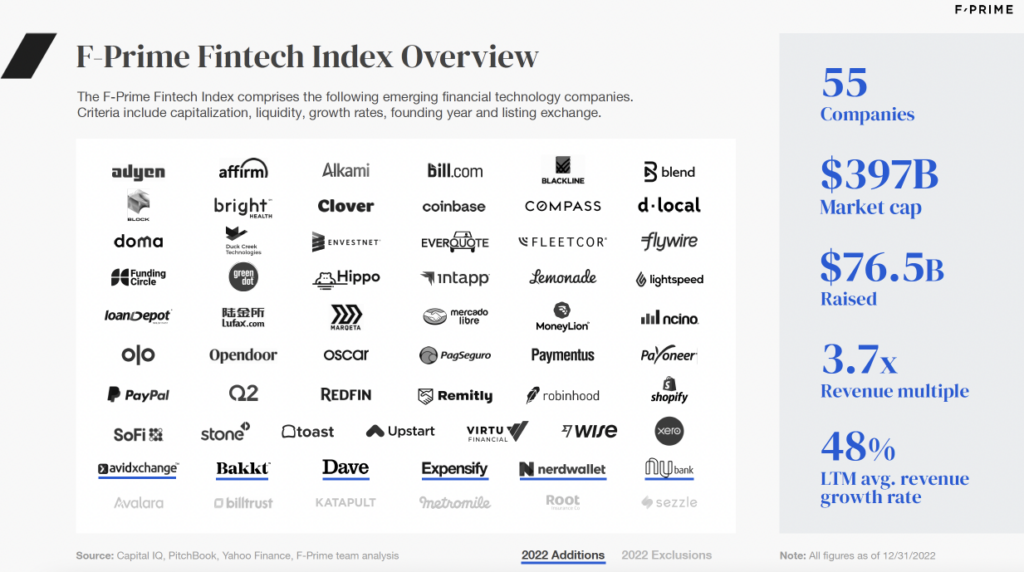
With last year’s addition of Nubank, the number of Latin American companies in the F-Prime Fintech Index grew to five, including PagSeguro, MercadoLibre, Stone, and dLocal. The F-Prime Fintech index is designed to track the performance of emerging, publicly traded financial technology companies.

In this story for LatamList, Rocio Wu discusses the year that was for public Latin American fintech companies, and their unusually strong performance relative to the broader sector in 2022.

Read the full story here.

2022 Was The Calm Before The Storm For Tech Startups

A few words on the year ahead

For early-stage tech investors, 2022 was the year to talk about the correction in the public markets and ensure your portfolio companies had 18-24 months of runway. As we approach the end of that runway, the realities of over-funding and over-spending are setting in.

I lived the dot-com and 2008 corrections, and unfortunately 2023 is bound to be an incredibly challenging and unpleasant year for founders, tech employees, and investors.

Many private companies will be just fine. Indeed, one thing that separates the last decade from the dot-com era is the fundamentally high quality of today’s business models. The roots of today’s crisis owe more to excess capital and unconstrained spending.

We are going to see four scenarios return that were largely absent for the last 10 years.

I’ve seen examples of them all over the last 60 days.

1. The quiet wind down. Startups that cannot raise sufficient capital at any valuation are shutting down and sending heartfelt thank you emails to their customers. Sadly, these won’t always be “bad businesses,” but for a variety of reasons – team, lack of traction, out-of-favor sector, down-rounds that are simply too draconian — investors just will not invest more capital (despite all the “dry-powder”).

2. The strong(er) acquire the weak(er). Every well-capitalized and scaled startup ($50M+ revenue) is drafting a list of target acquisitions. Every poorly capitalized, but semi-scaled startup has a list of acquirers. While there will be a lot of talking, the targets will rarely get “fair value” because acquirers have so many choices and will view every acquisition opportunistically – if they can’t get a good asset at a great price, they will move on to the next.

Valuing businesses is itself a challenge, especially when everyone knows the last-round valuation was too high. Investors and founders will opt for simple heuristics like exchange ratios based on ARR or gross profit. In reality, there is not much value in building discounted cash flow models (DCFs), but the target will struggle to capture value if it’s growing two or three times faster than the acquirer. Exchange ratios do not, but if the target is lucky, it can get a higher multiple on their ARR or gross profit than on the acquirer’s, to reflect that growth differential. Unfortunately, in this environment that will rarely happen.

3. VCs play match makers. Investors will catalyze business combinations for good reasons – gaining scale while reducing competition – and for bad reasons — one problem portfolio company is better than two. Obviously, founders should be leery of the latter and evaluate the M&A on its merits.

4. Recaps return. Recaps are down-rounds with bombs attached. They target two problems – co-investors who won’t or can’t invest more capital, and management teams that will need more equity to be incentivized following the down-round. With pay-to-play and pull-through provisions, early investors will suffer major dilution and/or lose preferred stock rights if they do not invest more capital.

Recaps are appearing and they will be contagious. Investors who have been subject to them in one portfolio company will introduce them at another. And as investors invest more capital than they had reserved to protect their earlier investments, they will shift reserves from one company to another inducing the vicious cycle. Fortunately, founders of fundamentally good businesses can come out OK with post-round equity top-ups, but there will be a lot of collateral damage.

While these will be challenging times for many startups, being aware of these scenarios and approaching them proactively and with the right mindset will help founders and investors alike. Great businesses continue to founded, disruption will continue, and a lot of investor capital is available for the future.

Video Interview: The State of Fintech and Why We Can Expect Significant M&A in the Space for 2023

Last year was the calm before the storm for private fintech companies, so we are going to see a lot of market consolidation this year.

Rocio Wu discusses our State of Fintech Report with Jill Maladrino on Nasdaq TradeTalks, covering how investors weighed the growth potential in the fintech sector in 2022, how they’re being valued now, and what investors can expect in 2023.

Originally published by Nasdaq TradeTalks

Assessing the State of Fintech

Fintech was on fire in 2021. A record 77 fintech companies went public, which included eight of the largest 10 exits in history.

However, in 2022 public investors re-appraised many fintech companies, prioritizing capital efficiency and shifting valuation multiples to align more closely with traditional financial services businesses. The F-Prime Fintech Index declined 72% over the course of 2022. Rising interest rates and macroeconomic uncertainty added to the significant valuation declines with certain fintech verticals seeing larger declines. Despite the drop in valuations, fintech disruptors grew rapidly, continued to capture market share, and give venture investors many reasons for long-term optimism.

New Logos in the Fintech Index

The average company in the Fintech Index lost 56% of its value in 2022. Companies that listed between 2020 and 2022 — two thirds of the companies in the Fintech Index — fared even worse, falling 65%. Because the IPO market came to a halt in 2022, there were few additions to the Index. Of the six new companies added to the Index last year, only Dave went public in 2022. The others — AvidXchangeBakktExpensifyNerdWallet, and Nubank — all went public in Q4 of 2021 and, per our methodology, required 90 days to “season” before we added them to the Index.

We also saw three acquisitions of Fintech Index companies in 2022. Metromile was acquired by Lemonade, Vista Equity Partners took Avalara private, and EQT Private Equity did the same with Billtrust. Meanwhile, Katapult, Root Insurance, and Sezzle failed to meet the criteria to remain on the Fintech Index, and were therefore removed at the end of 2022.

state of fintech 2022

Variation Across Verticals

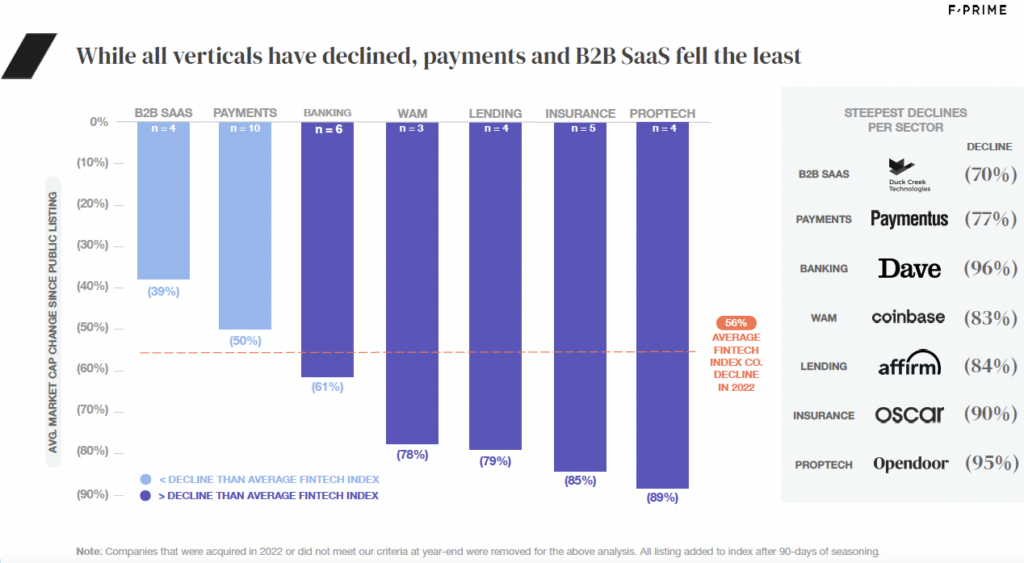
While nearly all tech and fintech stocks fell in 2022, the Fintech Index reveals meaningful differences across fintech verticals. We saw the steepest valuation declines in proptech, insurance, lending, and wealth/asset management — verticals that are especially exposed to rising interest rates and thin liquidity markets. Unsurprisingly, B2B fintech and payment companies saw less than average declines.

state of fintech payments declined the least

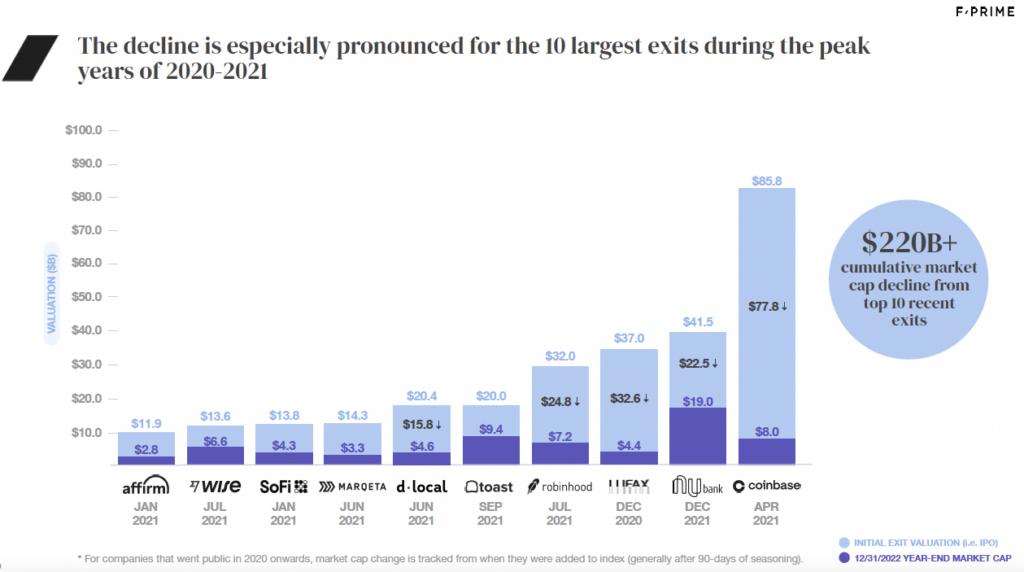
Fintech Index companies that went public in or after 2020 exited at a peak market, leaving them vulnerable to significant losses in the next downturn. Companies like Coinbase saw a 90% decline in market cap over the course of 2022.

fintech decline 2022

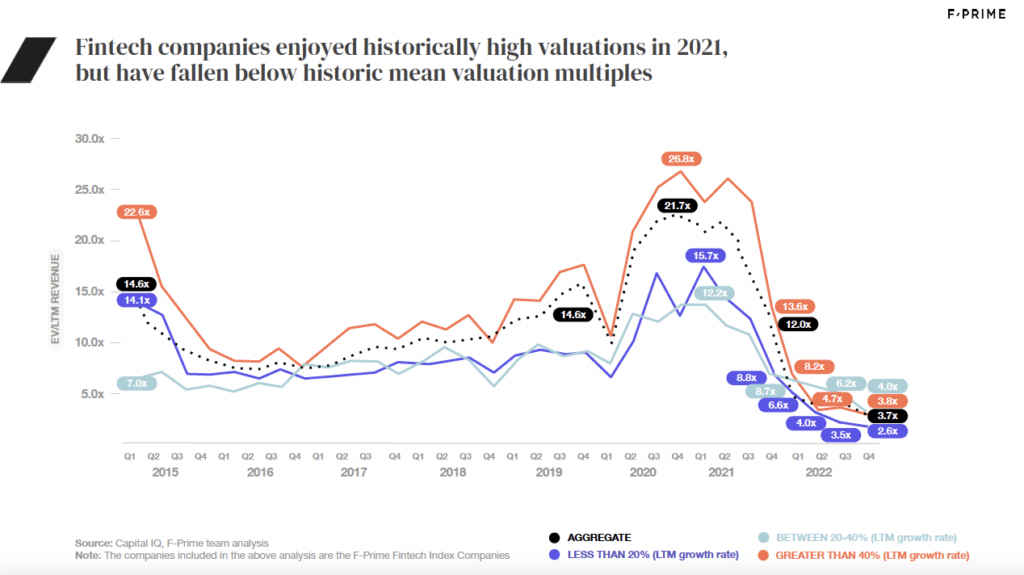
Some of those corrections appear to revert company valuations to historical norms. Others are especially large, with multiples significantly below historical averages as public markets begin to distinguish tech-enabled versions of existing financial institutions from truly disruptive approaches to financial services.

state of fintech multiples

New Metrics to Capture a Diverse Sector

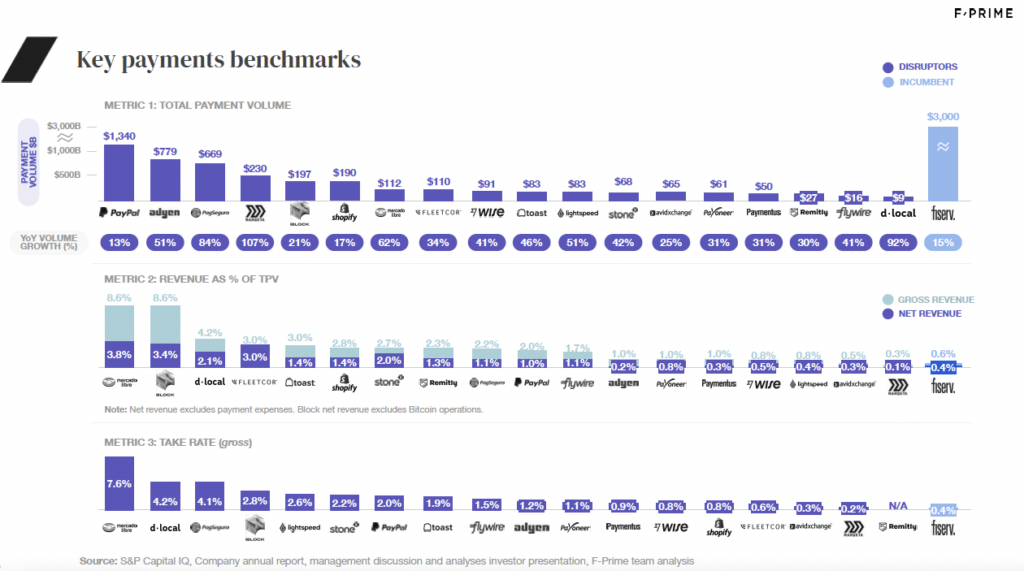
Compared to SaaS companies, fintech business models vary greatly across verticals. Thus, we need to evaluate the diverse set of companies within each fintech vertical distinctively. In response, we are adding new vertical specific metrics to the Fintech Index so they may serve as a quick reference for founders, investors and others to benchmark against recently listed public disruptors and incumbents in the financial services sector.

payments benchmarks

In its current state, the Fintech Index can highlight top-performing companies in each category, however over the coming months we will roll out dynamic charts showcasing key benchmarks across fintech verticals.

The Year Ahead

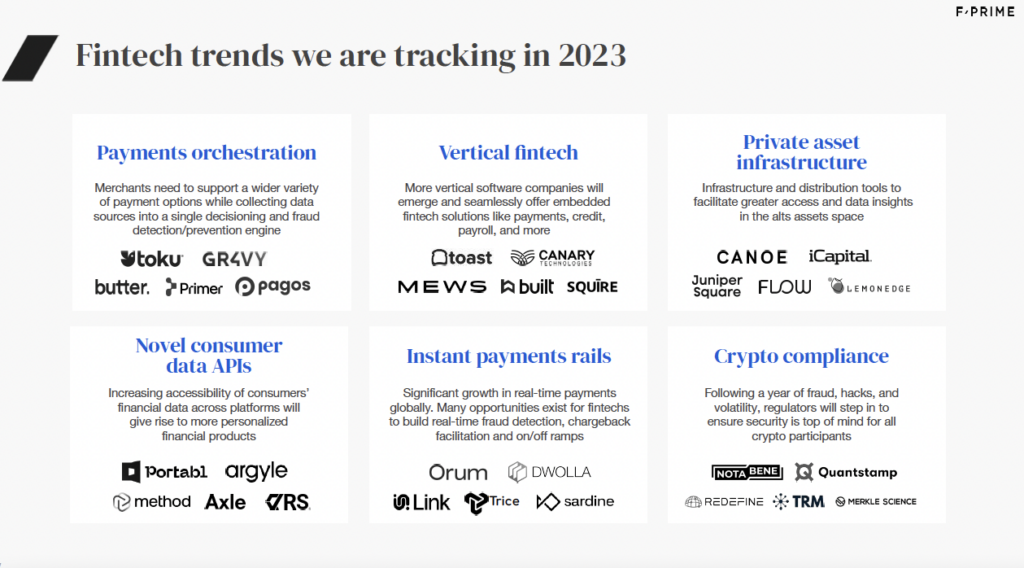
We’re tracking a number of disruptive trends across all fintech verticals, however below are some of the areas we are particularly excited about in 2023:

fintech trends we're tracking

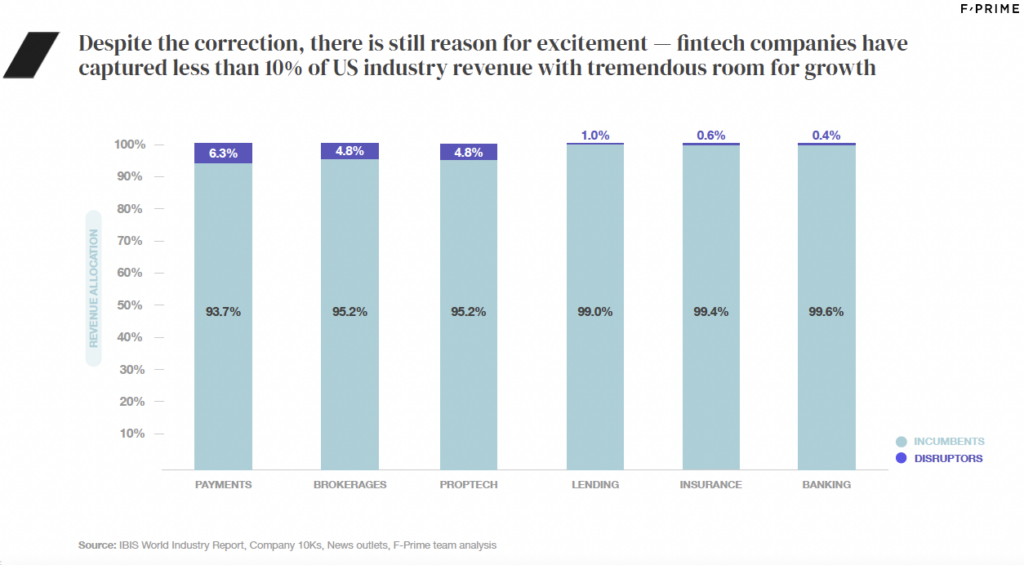
While 2022 was a tough year for fintech, we remain steadfast in our conviction that this is a great category to build and invest in. For one, fintechs are still in the early innings of capturing financial services revenue share — right now, fintech companies have captured approximately five percent of total financial services industry revenue.

reasons for fintech excitement

Meanwhile, fintech continues to eat the world as the embedding of fintech products accelerates across new verticals. As early backers of Toast and Flywire, we saw this first-hand in the restaurant industry and higher education. We see this in other verticals where disruptors like Shopify, ServiceTitan, Procore, Mindbody, and others are doing the same. Embedded fintech not only centralizes and improves the experience for users — it also increases TAM and makes previously overlooked verticals more interesting as ARPU/ACVs can increase 2–5x.

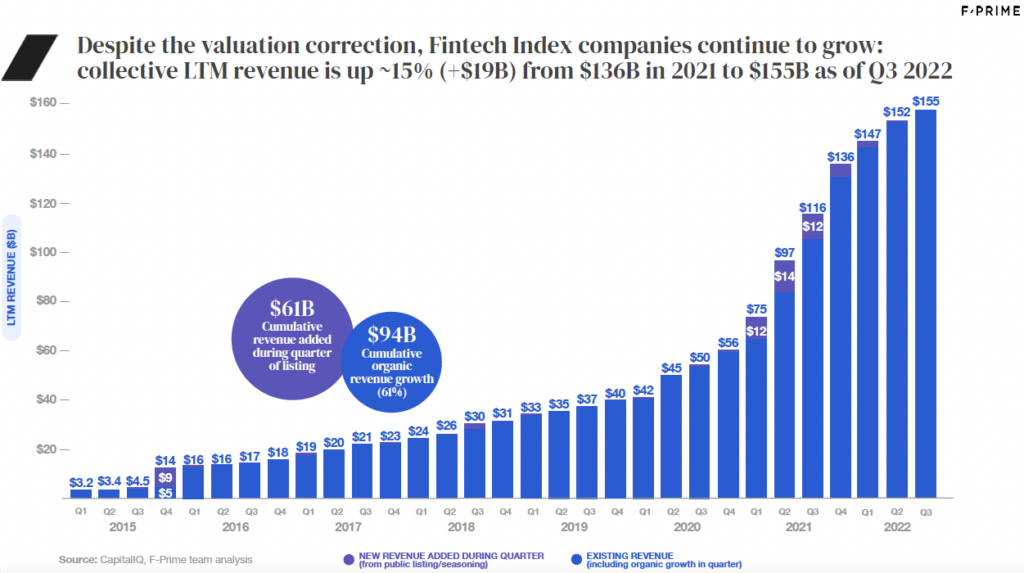
Finally, disruptors are both growing the pie and taking market share from incumbents. In the first three quarters of 2022, Fintech Index companies grew revenue 45%+ on average, and added $19 billion in revenue collectively to the Index. Furthermore, the vast majority of that growth was organic, as no new companies were added to the Index after Q1 2022.

fintech valuation

We also expect M&A to pick up dramatically in 2023 and especially in 2024, as buyers and sellers find valuation alignment. As mentioned earlier, private equity firms have increased their acquisitions of Fintech Index companies and we expect more buyout transactions — for example, DuckCreek is due to be acquired by Vista Equity Partners in 2023. We will remove the company from the Index once the transaction closes, as we did with the three aforementioned acquisitions in 2022.

Beyond that, we encourage you to dive into the report and join us on Thursday March 9th for an online discussion of its findings with the F-Prime team. What do you think of our conclusions? How excited are you for those new dynamic metrics to drop? And what are you most looking forward to in fintech-land in 2023? Drop us a line on Twitter and LinkedIn — and if you’re building or investing in fintech, let’s connect!

Who Will Build the Bloomberg of Private Markets Data?

Our Series B investment in Canoe Intelligence

I recently wrote about the need for a new digital tech stack for the Alternatives fund industry. The human and paper-based workflows of venture capital, private equity, and private credit create a generational opportunity for entrepreneurs to a) digitize investor onboarding, b) modernize the back office, and c) generate an unprecedented layer of analytics-ready private fund data.

Many talented founders are building businesses to address the first two opportunities. It is still early in product execution and adoption, but startups like Flow, Entrilia, Juniper Square, +Subscribe, LemonEdge, PassThrough, Sydecar, Asset Class, and Canopy are building the future of private fund infrastructure.

The Data Problem

The data layer, however, is another matter. Fund managers almost exclusively rely on PDFs to share data with their limited partners (LPs), and there is little sign of this changing soon. We estimate that well over 100 million PDFs are sent annually, with most recipients manually entering the data into their accounting, reporting, and analytics systems.

That is too much redundant data entry, and ultimately leaves a lot of valuable data unextracted and under analyzed. Until fund managers digitize their fund operations and add APIs for data distribution, LPs are going to suffer. Players like Cambridge Associates will retain well-paid analysts to speak with fund managers, gather their data manually, and distribute benchmarks (and yes, really) through more .pdfs.

A Better Future

Now imagine a world where all private equity performance and holdings data is digital, where investors can download historical performance, review investment history, and create their own benchmarks and reporting. It is not hard to imagine because it would look like the public markets, where even Yahoo Finance has decades of analytics-ready data on nearly every equity and debt security in the world.

I anticipate three phases to this transformationFirst, startups must meet the Alternatives industry where it is today – flat files like PDFs and spreadsheets. Domain-specific machine learning (ML) models can automate data extraction, classification, and normalization. While some worry that open-source ML models threaten these businesses, I see startups building defensible businesses across many industries through the thoughtful integration of open-sourced ML-models, proprietary domain-specific AI, and humans. Over time, their focus on one industry also yields a data advantage and network effect –  multiple investors in the same fund using the same quarterly report, for example. Ocrolus in SMB lending, Snapdocs in mortgages, and BenchSci in pharma R&D are all good precedents.

Eventually, fund managers will modernize their accounting and fund admin, and some will distribute data digitally. This will be a great step forward. As an early investor in Quovo, I recall the initial reaction when banks did the same thing. They published APIs and told aggregators like Plaid and Quovo to use them. At first that was concerning, but aggregators quickly realized their data aggregation costs would actually decrease – while their real value-add remained. In Alternatives data, startups that have built strong customer relationships will also benefit; LPs/investors in private funds are really paying them to distribute clean, normalized data from thousands of private funds that lack common data definitions and categorizations.

And that leads to the third phase, where the leaders have the chance to become the Bloomberg of Alts data. It’s hard to believe, but there is no official “security master” for private funds, like we have for stocks and bonds. There isn’t even a common taxonomy for fund returns – I say MOIC; you say CoC. And, of course, not all funds report all metrics. With access to years of fund performance data from a broad universe of private funds, startups will have a remarkable opportunity to help investors analyze fund performance better and faster. Another exciting implication is that easily accessible alts data and analytics will lower the barrier for financial advisors and accredited investors to participate. Ultimately this is great for advisors who need to explain their recommendation to clients, and for private funds who are working to expand their investor bases.

Partnering With Canoe Intelligence to Build that Future

Abdul and I, and everyone at F-Prime Capital, are thrilled to partner with Canoe Intelligence in their pursuit of this goal. Together with Alston Zecha and Jens Neisius from our European fund Eight Roads Ventures, we led their recent Series B and are impressed with everything Canoe has accomplished already. They have a great ground game, stellar customer list, top-quartile SaaS metrics and a leading tech platform that is only getting better with scale and network effects. We have wanted to be a part of the solution in Alternatives data for many years, and we’re excited to see Canoe lead the industry. Paddle on JasonMikeVishalMichelleJoshSethTim, and everyone on the Canoe team!

How Startups Can Help You Win the Talent War With Tailored Employee Benefits

The employer sales channel has inherent and often overlooked advantages.

In 2021, nearly 50 million workers voluntarily left their jobs. The median tenure of employees over the age of 25 has dropped from 5.5 to 4.9 years since 2014. On average, employees 25 to 34 now stay at jobs for less than three years.

This isn’t just “quiet quitting.” U.S. workers are ready to move on from their current jobs — and they’re sending that message loud and clear.

In a story for VentureBeat, John Lin and Sarah Lamont outline how a tight labor market poses a number of opportunities for certain startups to sell their products and services as employee benefits.

Originally published in VentureBeat. Read the full story here.

What Founders Need to Know Before Selling Their Startup

The most common theme for these conversations was simply: “I wish I had known then what I know now.”

Throughout his career, David has experienced 11 different acquisitions from multiple perspectives: as a founder, an investor, and a Board member. Recently, he recently went on a listening tour to compare his experience with the post-acquisition stories of a wide range of acquired founders — and then shared his findings with Harvard Business Review.

Originally published in Harvard Business Review. Read the full story here.

Prime Medicine: Advancing a next-generation gene editing technology

Using “search and replace” to address the fundamental causes of genetic disease.

Developed in the lab of Dr. David Liu at the Broad Institute, Prime Medicine was founded to deliver the promise of gene editing to patients with genetic diseases.  The ability to introduce nearly any desired edit to restore normal genetic function has long been viewed as the ‘holy grail’ in the gene editing space.  While there are approaches to accomplish this with first generation CRISPR-based technologies – which are based on introducing double strand breaks into DNA – efficiencies have historically been low (these technologies are very well suited to introducing gene disruptions). Base editing was a significant step forward in gene editing, but the technology only allows for select base-to-base changes.  Prime editing introduced, for the first time, the ability to efficiently introduce any base-to-base edit as well as to correct insertions and deletions, creating an opportunity to address more than 90 percent of known disease-causing genetic mutations.

First-generation CRISPR/Cas9 technologies can be likened to scissors, base editing to a pencil and eraser, and Prime Editing to a word processor, enabling search and replace genome editing and representing a significant improvement in precision and breadth of possibilities.


“F-Prime was with us from the beginning and shared our vision for the promise of Prime’s technology. Together we can deliver hope to patients and families suffering from incurable genetic diseases.”

Keith Gottesdiener, CEO


At F-Prime, we believe that Prime’s transformative technology is a major advancement towards their vision of creating a world where Prime Editing can potentially cure, halt and ultimately prevent genetic diseases.

It was an honor to support Prime through their Series A and Series B funding rounds alongside other leading healthcare investors. We share a common goal to improve the lives of patients with a wide range of genetic diseases.

Announcing our Investment in Deal Engine

Our latest Seed round in the travel tech space

Almost three decades into selling flights online (thanks Travelocity!), the cobweb of infrastructure that supports the travel industry has not modernized to meet the complexity growing at the surface.

Code-share agreements, ancillaries, vacation packages, layers of wholesalers, and other “business innovations” have led to booking and customer service nightmares for passengers, agencies, and airlines themselves. A simple change or refund often requires a call to customer service (have four hours to wait?) that descends into manual reading and interpretation of fare rules, calls from OTAs to airlines for clarifications, tax estimations (you’d be surprised), and other unenviable manual tasks. As important as the Global Distribution Systems (GDS’s) have been in digitizing the travel market, the pandemic highlighted the challenges the industry faces when so many of its “normal” operational processes still require human artistry to Get Stuff Done.

We believe Deal Engine, which announced its $5.3M Seed round led by F-Prime Capital today, has an opportunity to be the travel industry’s agent for digital transformation. By building a new infrastructure layer that abstracts away the complexities of fare rules and travel policies with a powerful machine-learning based engine, Deal Engine enables their partners (OTAs, TMCs, or airlines) to automate the transactions that used to be manual. The most complex changes and refunds can now be executed with a simple API call, initiated by a customer service rep or the customer themselves with the push of a button. This capability has the potential to transform the post-booking customer experience, shifting focus from cost reduction to revenue generation — all while giving the consumer the amazing experience that online travel promises.

The leadership team at Deal Engine — including Alex JaraDavid Gomez-Urquiza and Isabel Carrera Quiroga — possess tremendous courage and domain expertise to tackle such a massive problem in travel. They have not been shy about bringing their disruptive solution to the behemoths we all know and sometimes love, leading Deal Engine to serve a who’s who of players in the travel industry. Betsy Mulé and I are excited to be partnering with this team, which is doing the truly hard work of making travel better for all of us.

Shout out to Thayer VenturesPAR Capital ManagementPlug and Play Tech Center and Brook Bay Capital, LLC, who also participated in the round.