Goodbye SaaS, Hello CAVA
Goodbye SaaS, Hello CAVA
Where the AI boom is headed in healthcare, and why the old athenahealth business model may look new again
At age 25, I was the practice manager of Athena Women’s Care, an OB-GYN practice in Rhode Island during the early days of athenahealth, which morphed later into the massive SaaS+services company that Bain Capital acquired for $17 billion. That office was the front lines because we were a bunch of entrepreneurs trying to “make healthcare work the way it should.” To us, this meant better care that costs less and reaches everyone, all at once, a feat that healthcare nerds call “the iron triangle” because it is supposed to be impossible, like a healthcare version of the Triple Lindy. We had bought the medical practice to show we could manage well, and we nearly went bankrupt in the process. Thankfully, our confusion and desperation led us to build athenaNet, the world’s first internet-based platform for running medical offices, which became the business. When Venrock led our Series A in 1999 ($10 million on $11 million pre, which now sounds like a badly priced seed deal), the two requirements alongside the investment were (a) get out of trying to run medical practices and (b) hire at least one grown-up executive.
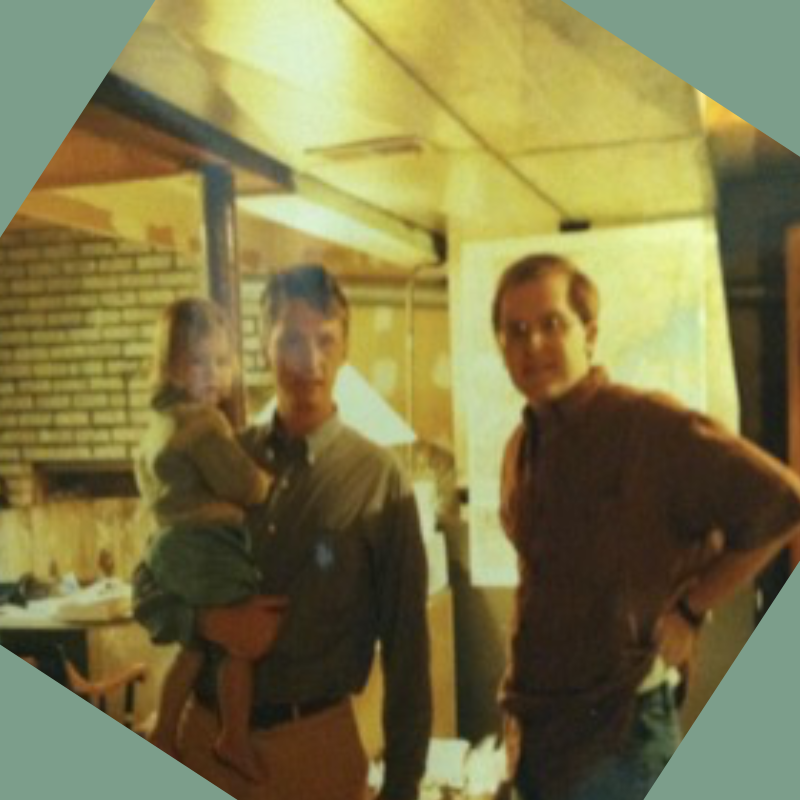
 athenahealth Headquarters, the basement at 97 Codman Road, Lincoln, MA. Nicola Bush, Jonathan Bush, and Carl Byers (left to right)
What made athena’s model special was that we weren’t selling software, we were selling business outcomes. We charged a percentage of practice collections, much like Visa gets a piece of every transaction that hits your credit card. We knew practices needed this because we had been in their shoes. The sheer despair and anger associated with hundreds of insurance products, each with its own set of endlessly complex rules, made independent physicians want to simply give up and sell to larger entities. We dedicated ourselves to giving doctors “more money, faster, with less hassle.” So, we sold them the end result, cash in their bank account, and priced our services accordingly. The fact that our approach required them to rip and replace legacy software was incidental. We needed the office staff and doctors using our software so we could see and fix the problems before the patient and the provider left the medical office, allowing the medical claims to be paid on the first attempt. By doing the billing ourselves, we built a proprietary understanding of all the rules as a shared utility, so learning associated with any customer benefited everyone else on our network.
 Excerpt from athenahealth Form S-1 / IPO prospectus, 2007
When we went public, the reason our stock doubled on the first day of trading was that a group of public investors understood the value of tech-leverage and recurring revenue; SaaS was new in Silicon Valley, popularized by companies like Salesforce. After our debut, healthcare investors were shaking their heads when the value of athenahealth exceeded $1 billion, but the tech investors thought it made sense. Time proved those tech investors right.
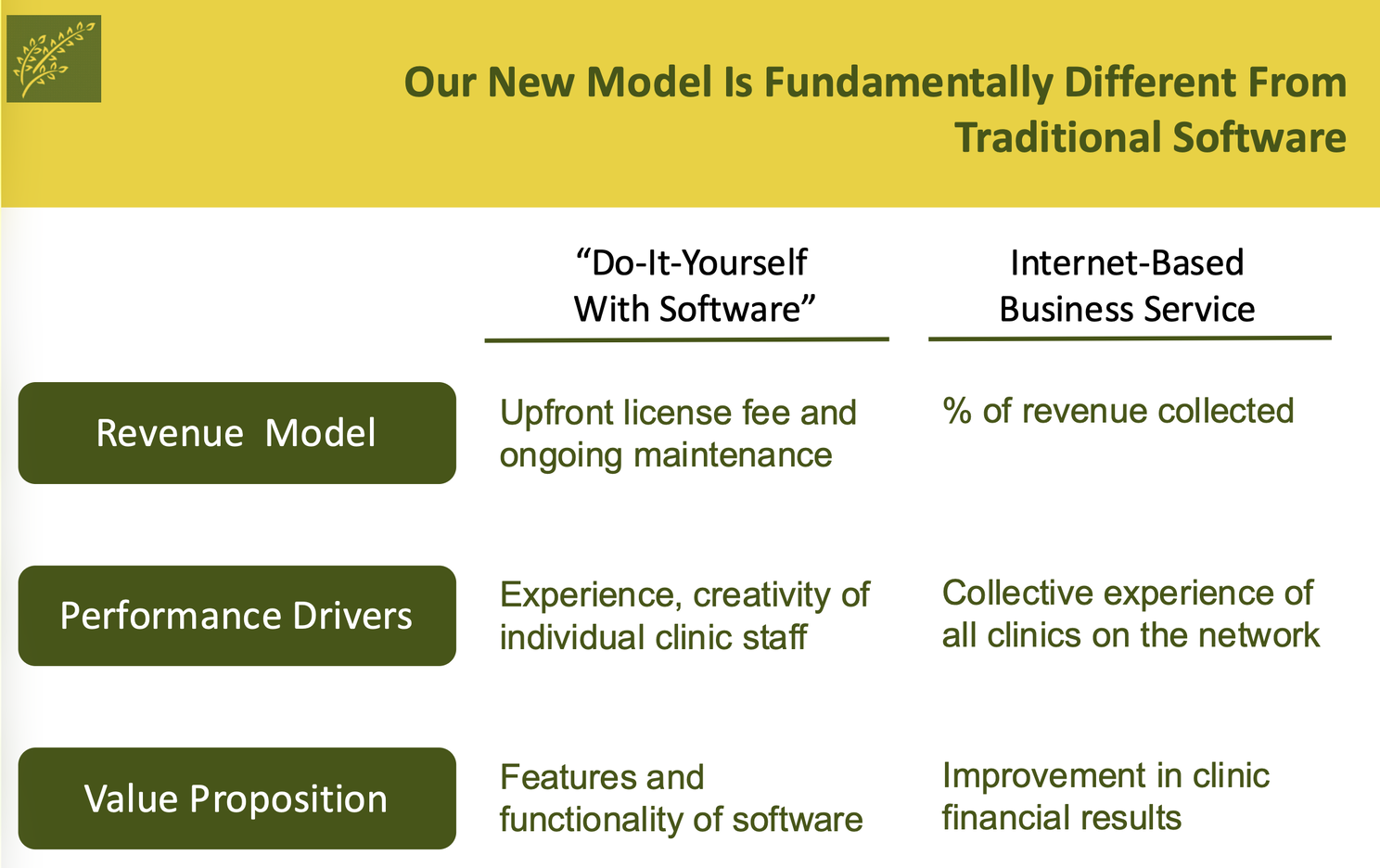 Excerpt from athenahealth presentation during IPO road show, 2007
The lessons of the athenahealth story are surprisingly relevant to the AI moment, and they point to a role for AI that goes further than what most people envision. The underlying assumption in SaaS is that humans are central to software design; countless UX and workflow decisions are made with this in mind. Systems of record were built to be clicked through, one field at a time, by staff who captured only what the screen asked for. Later, “systems of engagement[1]” were introduced on top of “systems of record,” to improve workflows without distorting underlying records; they made clicking more pleasant and, at times, more automated, but they didn’t disrupt the underlying model as the users remained primarily human.
An agent can understand the payer contract, the claim, the chart, and the remittance itself; the data is captured because the work got done, not because someone remembered to document the work. If you point an agent at a system built for humans, existing screens, seats and workflows are an obstacle rather than an enabler. In this sense, agents don’t just make SaaS cheaper to build; they imply a fundamentally more efficient architecture. SaaS platforms will not die, just like snail mail didn’t die, but we should expect value to shift away from SaaS toward an entirely new “tech-frastructure.”
 Times Square image, 9/20/2007; photo by author
At athenahealth, we employed thousands of people to fill the gaps between what our software could do on its own and the requirements of the healthcare system; what we lacked was scalable intelligence. With AI, we can now build “athenahealths” that are far more powerful and eliminate much of the human work involved in closing gaps. I call this CAvA: Completely Automated via AI, which is a “limit case,” the direction of travel for architectures and tech stacks, rather than a description of any company today. I offer this concept during a very loud debate about the dangers of AI, which need to be taken seriously. Healthcare is one place where most of us can agree that resource limitations are screaming out for technology to lighten the load. CAvA would remove much of the administrative bloat that drains our system of scarce dollars and stands between people and the care they need, which is why this transition, costs and risks included, is not just worthwhile but imperative.
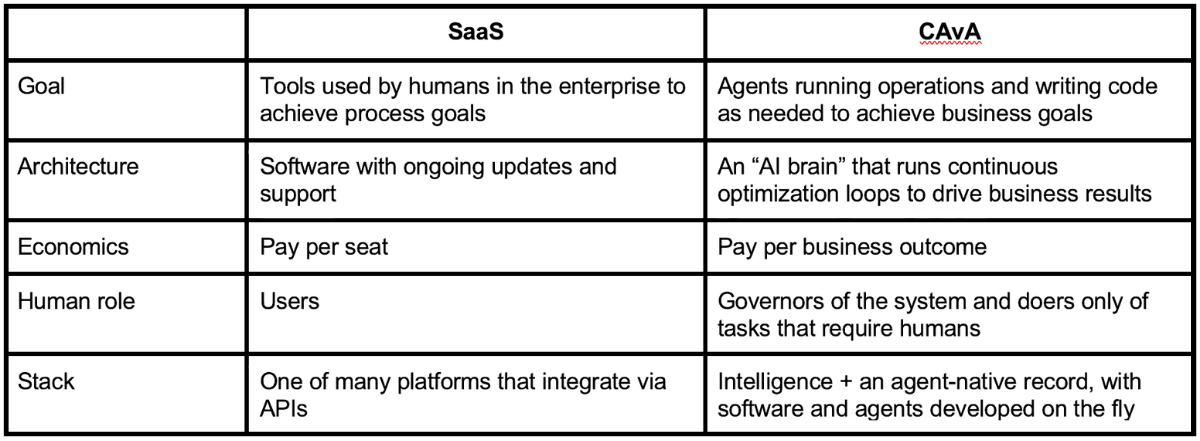 Table of SaaS vs CAVA components
Just like with the athenahealth business model, CAvA is about integrating software, knowledge and work into one platform that is paid for based on business outcomes. Athenahealth’s “completed result” for its customers was a paid claim; a true CAvA entity could be a “pay-vider” not unlike what is being built by athenahealth veterans over at Devoted Health today. Devoted[2] still has a lot of people, but those people have embraced AI to an extent never seen before in our industry and the early results are enormously promising. Today, Devoted achieves high Star ratings and competitive medical loss ratios while running the company at an administrative expense ratio far below the benchmarks of much larger incumbents. I think of Devoted as essentially a set of optimization loops running continuously across the company’s customer-facing, clinical, and business objectives. Its revenue model is not based on its use of technology; its top line is the Medicare Advantage premium dollar. No company is fully “there yet,” but a true CAvA entity would assign work to humans only when it must, because AI can’t yet do the task, a regulator or a board requires a person, or the customer wants a familiar human face.
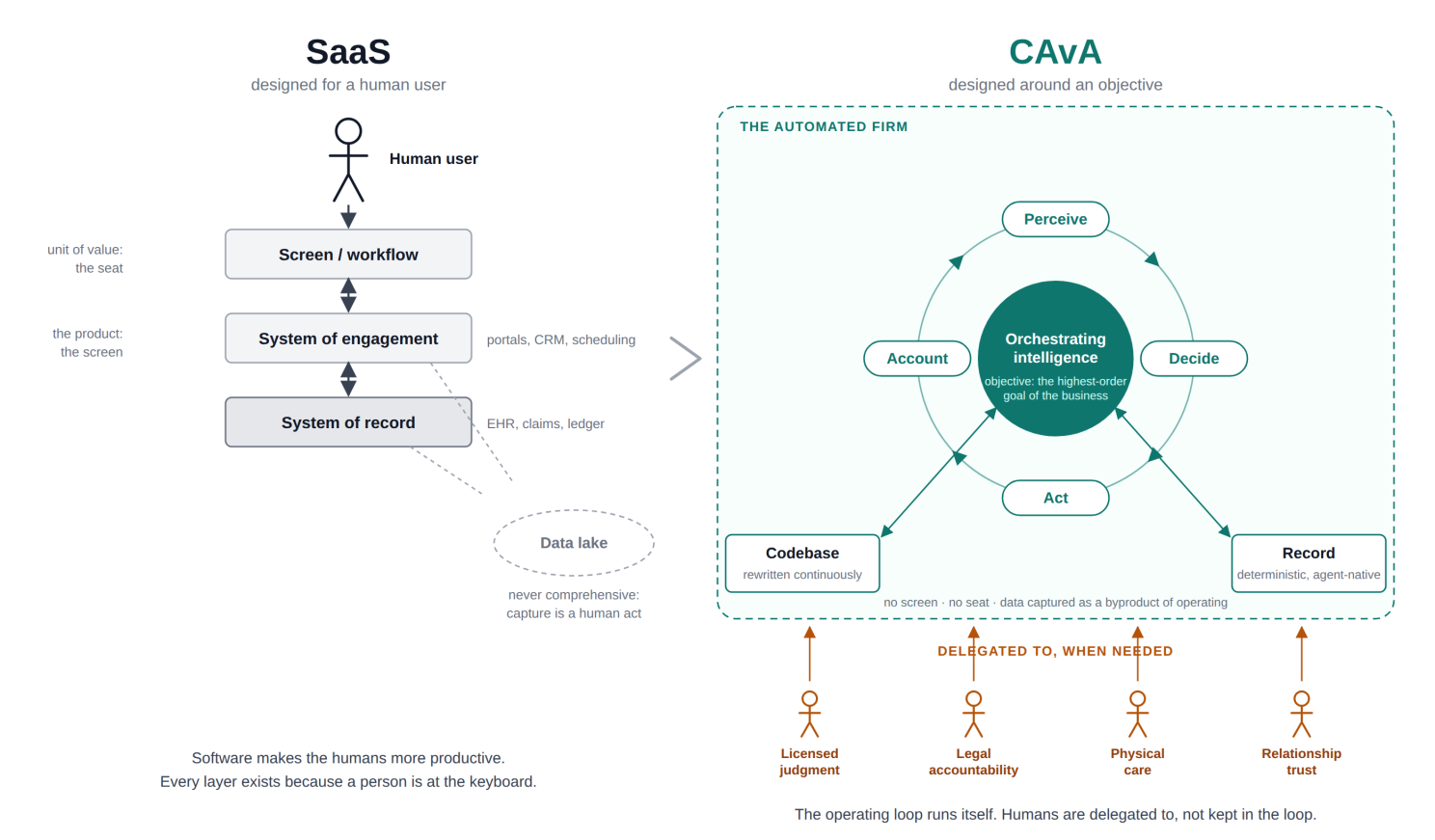 Illustration of SaaS vs CAvA architecture; and yes, I asked Claude to help me convert this from my whiteboard
Key to this model is that humans are no longer central to the architecture because agentic AI can replace the work of those users. By doing so, the system becomes far less constrained by human throughput and can expand its scope to subsume all business functions comprehensively. Such a model can iterate rapidly without slowing down to bring us along. In that world, a highly capable AI orchestration layer and a comprehensive, agent-native record are the foundation, with software tools and agents spun up as needed to get work done, and humans handling whatever gets delegated to them. I say this is a limit case because AI likely needs to continue to evolve before the CAvA approach will truly be “complete”; however, if start-ups rethink their value propositions with this model in mind, they can stay ahead of the curve. As seen with agentic coding, it is far easier to have a cohesive codebase that is run by agents from day one than it is to adapt legacy codebases to the new paradigm.
As we aim for “completeness,” we cannot forget that every business needs accountable humans and all clinical actions need to be appropriately authorized, typically via a licensed provider. While the FDA has begun clearing autonomous AIfor narrow diagnostic tasks, regulators will not simply hand over control to bots without rigorous oversight. Customers wouldn’t pay for that either; safety and transparency need to be fundamental to the CAvA architecture. In this way, the CAvA model is about everything that goes into providing value for the customer but not the governance of the organization itself. Outside of that loop, at least for now, sit legal accountability, licensed clinical judgment, and the relationships people want to be off screen. While systems of record may no longer be as central to how providers operate as they are today, we still need records and those records will need to stand up to audits. Having a complete operating loop with auditable records and accountable humans is a key challenge of bringing about the benefits of a CAvA future.
What would the first real CAvA entity look like? The roots of the answer may be in that Rhode Island billing office where athenahealth began. It would be athenahealth with no billing staff. The revenue cycle is a great starting point because it already is priced on outcomes, so the business model doesn’t need to change, and the labor being replaced is not licensed. If a medical claim is mishandled, no one is harmed directly, so that also points toward administrative functions rather than clinical ones in the early innings of our CAvA future. Athenahealth spent two decades and thousands of people encoding payer rules into a shared utility. An AI-native version of that utility, one that reads the contracts and remittances itself and rewrites its own rules when the payers change theirs, is buildable today. After RCM, the next priorities should follow licensure requirements: payer operations like eligibility and prior authorization, and then patient access and care navigation, with clinical care delivery last (apart from pre-visit triage).
Through my firm, we have invested in companies that see this future coming and are working rapidly to evolve into “systems of action,” on the path toward CAvA. Systems of action take on the work of people, shifting the TAM from the tech budget to a large portion of opex. Unlike systems of engagement, systems of action do not play nicely with underlying systems of record, because once they are doing real work, they are held back by the design of the system of record. This is likely to lead to a realization that the legacy system of record has to be rebuilt, a challenge made less daunting by the fact that an army of bots can write code 24/7 to make that happen, in a way that is unpolluted by the tech debt of those bots’ human predecessors.
Spry helps physical therapy (PT) practices with documentation but is moving quickly toward meeting the comprehensive needs of PT practices, including the revenue cycle. Eleos automates documentation, compliance, and RCM in behavioral health practices; over time, it aims to orchestrate nearly everything outside the clinician-patient relationship. Finally,Notable has always been focused on end-to-end workflow, and the advent of AI enabled its evolution into a platform of intelligent agents capable of taking on real work (where each completed task contributes to making the platform smarter). Accordingly, Notable’s pricing has shifted from per-seat to usage-based; outcomes-based pricing is the next logical step. None of these three examples is fully a CAvA entity today, nor do they claim to be, but they are well positioned to make full automation their north star.
The broader implications of this approach are significant. Building from scratch can be far more efficient than adapting existing platforms designed for humans (with large, human-shaped, legacy codebases). Start-ups are not beholden to sunk costs, established products, channel conflicts, or short-term earnings pressures. This evolution is likely to come in fits and starts; the transition from SaaS to CAvA will be neither subtle nor incremental, because it means moving past “we sell technology” to “we deliver outcomes.”
Here are a few of the possibilities in healthcare, some nearer term than others:
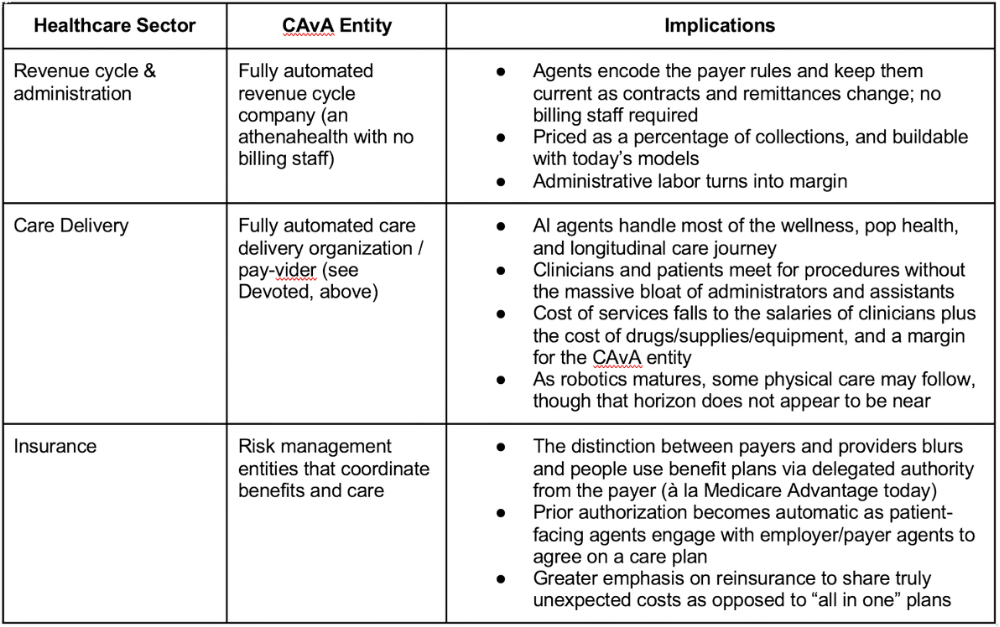 Potential implications of CAvA model in healthcare
The scope of change implied by this model is dramatic because technology would become both front and center – as the AI brain behind the coordination of all care – and more in the background, because customers will purchase the end result rather than the technology tool.
If this vision were to come about, here are suggestions on how to thrive in a CAvA world:
- Go deeper in areas where you have specialized expertise and proprietary data; if you have data that the AI labs cannot see and is important, guard it and build on it
- Partner closely with customers to get deeply involved in care delivery rather than just providing a tool; become the indispensable partner of the care delivery entity on the pathway to a CAvA future
- Price on outcomes now, even if humans are still doing much of the work; charging a percentage of collections or a share of savings forces you to build the operating loop instead of selling seats, and it is what customers in a CAvA world will expect
- Consider going “full stack” and getting into care delivery, where the reimbursement is for completed episodes of care (and quality) rather than for technology or business process outcomes
The promise of this CAvA future is healthier populations and budgets, with high-quality care that is accessible and affordable. There will be plenty for humans to do, but it will be limited to the components of care that require a human. If the cost of care falls materially (as it should, when you automate), everyone should be able to access a baseline of high-quality care, with employers’ role shifting to providing benefits above that baseline.
Thinking back on that small OB-GYN office in Rhode Island where we first did billing on athenaNet, there was so much activity, communication, and chaos that related to the management of information and the coordination of people. If we truly want to make healthcare work the way it should, we should continue down this path. Let’s embrace the power of AI and focus humans on what only they can do. We went from paper to software and now we are going from software to agents. Having spent a lot of the last six years in Spain, I can confirm that the name is not a coincidence. Let’s raise a glass of cava to welcome the next frontier, CAvA.
Note: Many thanks to Brij Bhuptani, Jonathan Bush, Alon Joffe, Davina Magargal, Julia McDowell, Pranay Kapadia, Ed Park, Fay Rotenberg, and Adam Stansell for their input on drafts.
[1] This term was coined by the legendary Geoffrey Moore and was expanded upon by people like Greylock partner Jerry Chen, who talked in this regard about “the new moats.”
[2] Please note that Devoted, Spry, Eleos, and Notable – all mentioned here — are F-Prime portfolio companies.