Plaid Acquires Quovo — Another Brick in the New Financial Services Tech Stack

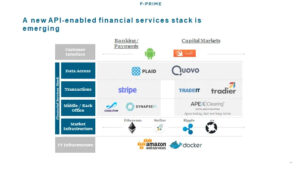
Last year I gave a talk at a FinTech Sandbox event about the new financial services tech stack, showing Quovo and Plaid emerging as the new data access layer. Last week, less than one year later, news broke that Plaid acquired Quovo for over $200M. This new infrastructure layer feels solidified.
F-Prime Capital co-led Quovo’s Series B round and I have had the joy of working with co-founders Lowell Putnam and Niko Karvounis as they willed their way through the challenging early years when no one but financial advisors cared about account aggregation, and later as they surfed the tsunami of new applications incorporating account authentication and aggregation. They did it with grit, humility and class.

In the future, I think we will look back on the Quovo-Plaid merger as a significant milestone in the FinTech wave of disruption. For one, I believe the combined Quovo-Plaid will become the data access layer in the new financial services tech stack. In addition, this merger is happening at the same time as authentication and aggregation move from a ‘nice to have’ to a ‘must have,’ and as we transition from building out the infrastructure to delivering analytics and insights. We are moving from Chapter 1 to Chapter 2, but it won’t stop there.

A quick view on the past, present and future.

Chapter 1: new consumer financial data infrastructure. Together Quovo and Plaid have helped millions of consumers connect their financial accounts to services like Venmo, Coinbase, Betterment and to a long tail of other financial service providers. They connect to over 14,000 financial institutions and provide clean consumer transaction data via APIs, making it easy for consumers to add a bank account for payments (e.g., Venmo), transfer funds into their brokerage account (e.g., Stash), see their categorized spend in budgeting tools (e.g., Personal Capital) and power frictionless rewards programs (e.g., Drop). They are literally everywhere consumers touch a financial service. They do not move money; but they provide the metadata, and in the process have enabled hundreds of new FinTech applications and services.

As a combined entity they will continue to build out the infrastructure in the US and soon the world, but we are already well on our way to Plaid and Quovo owning the data access layer of the new financial services stack.[i]

Chapter 2: analytics and insights. What do you do once you have poured the foundation? You build on top. Plaid and Quovo are now helping businesses analyze consumer data to make better decisions in an automated, real-time way. Lenders like SoFi use Quovo to estimate W-2 income when a consumer applies for a loan, rather than asking for tax returns. Stash uses Quovo to predict the best day to move funds from a consumer’s bank account to help them avoid overdraft fees. Insurance companies can quickly authenticate a policy holder’s bank account to direct deposit insurance proceeds, rather than sending a check. The surface area is wide and Plaid and Quovo should someday generate 3–4x more revenue from derived insights embedded into business workflow.

Chapter 3: what’s next? One inevitable path is for Plaid and Quovo to give consumers more tools to control access to their financial data. In all of my examples, consumers proactively permission use of their data, but what do they do afterwards? Consumers will need easy dashboards to track and revoke access when for instance they no longer use a service. Plaid and Quovo will be well-positioned to do this on behalf of consumers and may become consumer brands themselves in the process. The combined entity can turn over many other cards and it’s exciting to consider other ways they could leverage their data access and analytics, such as, to support identity or credit verification.

Closing thoughts

There are many issues to navigate, from Open Banking in Europe to privacy and regulatory concerns in the US, but I’m optimistic that the triad of regulators, financial institutions and data access providers will act sensibly and with consumers’ interests in mind. If so, the combined Plaid and Quovo has a tremendous future ahead.

And if all goes well, in several years closing documents for company mergers will not require investors to submit their bank account numbers in writing…the final irony in the merger of the two leaders in digital account authentication.

[i] To be fair, time did not start with Quovo and Plaid, and for more than a decade Yodlee (now part of Envestnet) was the data access layer and one of the great early FinTech success stories.

Josh Feinblum

Josh is a cofounder of Stavvy, a Boston-based fintech company, where he leads product, engineering, people, and finance. A lifelong technologist, Josh has focused on entrepreneurship, financial services, cybersecurity, privacy, and anti-fraud technology. Josh has been responsible for building and leading teams — from niche startups to large federal agencies — tackling some of the world’s largest fraud, abuse, and security challenges. Before Stavvy, he served as the Chief Security Officer (CSO) at DigitalOcean where he oversaw the legal operations, trust & safety, security, and fraud & abuse teams. Josh also launched Rapid7’s security organization, operating as the CSO he functioned as one of the corporate spokespeople and a member of the product leadership team. In addition to his operational background, Josh continues to serve as a professional advisor at the Martin Trust Center for MIT Entrepreneurship.

Josh earned his Bachelor’s degree from the University of Maryland and his MBA from the Sloan School of Management at MIT.

A student was tasked with sending his international tuition payment to the university — but the entire process lacked transparency.

While preparing to attend MIT in 2008, an international student was tasked with sending his international tuition payment to the university – but the entire process lacked transparency.

His payment couldn’t be tracked, so he had to hope that it would be delivered before the deadline—if it was delivered at all.  The payment was subject to fees and fluctuating exchange rates, affecting the total amount that would be actually delivered. Wire transfers rarely included essential student information universities required to post funds correctly. Schools frequently received insufficient funds because of the wire fees, and had to send additional bills to students or bar them from registering for classes. Confident a better process could exist, Flywire was created.

Flywire partners with schools and hospitals to receive payments from around the world, easily reconcile them with their accounting systems, and provide consumers with a seamless payment experience.

Mike Massaro was an early employee leading sales for Flywire that became CEO at the same time F-Prime invested in its Series A round. Mike has led the company to tremendous growth in the education sector and lead its successful expansion into the healthcare industry as well. It’s a world leader in vertical payments, having processed over $8 billion for 1,600 institutions.

Flywire aligned well with F-Prime’s investment theme of vertical payments. Flywire is a leading example of solving a simple problem with a great user experience and an elegant, scalable business model. Mike has built a truly global company with a culture of transparency, empowerment and authenticity. Flywire is headquartered in Boston with operations in London, Manchester, Valencia, Shanghai, Singapore, Tokyo, Cluj, Sydney, and Chicago.

Pony.ai

Founded in late 2016 by former Baidu Chief Architect James Peng (CEO) and programming legend Tiancheng Lou (CTO), Pony.ai aims to revolutionize the future of transportation by building the safest and most reliable self-driving technology.


An Eight Roads investment. Eight Roads is F-Prime’s sister venture capital investment group, with which F-Prime collaborates on investments outside of the Americas and Europe.

Mihir Shah

Mihir Shah is a veteran technology leader with over 30 years of experience in financial services and technology. He recently retired from Fidelity Investments, where he held several key leadership roles, including Chief Technology Officer (CTO), CIO – Enterprise Head of Data & Analytics, and Head of Enterprise Architecture. His core area of expertise is developing and executing on large, complex data and platform initiatives.

As CTO, Mihir led the modernization of Fidelity’s Asset Management platform, which now enables $5.6 trillion in assets under management. As Chief Data Officer (CDO), he spearheaded the development of a firm-wide, cloud-based data warehouse, unifying all data products into a single analytics platform. Earlier in his career, he played a pivotal role in enhancing Fidelity’s customer experience platforms, leading the rollout of CRM, Customer360, and Campaign Management by developing a unified data architecture for customer-facing channels.

Before Fidelity, Mihir led large-scale projects across the UK, Argentina, Singapore, and the US. He was the lead architect at Churchill Insurance in London, a pioneering startup in the UK insurance industry, and began his career at Tata Consultancy Services (TCS), contributing to its early growth.

In his post-retirement career, he is a Venture Partner at F-Prime, Eight Roads Europe and India. He also serves as an Advisor in Residence to EY and is on advisory boards of numerous companies including Snowflake, Writer, Reltio, Skyflow, Promethium and Finbourne. He remains engaged in academia as an Industry Fellow at MIT Sloan School of Management.

BlackDuck

BlackDuck secures and manages open source software worldwide, eliminating open source security vulnerabilities & license compliance pain. BlackDuck was acquired by Synopsys in 2017.


A Fidelity Ventures investment. Fidelity Ventures was a venture capital investment group affiliated with F-Prime until 2010.

mindSHIFT

mindSHIFT is one of the largest IT outsourcing and cloud services providers. The company has supported our clients with tailored and trusted technology solutions for more than 15 years. From day-to-day IT to major systems modernization, count on mindSHIFT’s technology expertise and personalized customer care for all of your IT needs. mindSHIFT was acquired by Roche Company in 2014.


A Fidelity Ventures investment. Fidelity Ventures was a venture capital investment group affiliated with F-Prime until 2010.

From the willingness to listen and the ability to innovate in the face of failure, a Boston unicorn is born.

Steve, Aman and Jon were at dinner when they realized the restaurant industry needed a serious tech upgrade. The three MIT grads had met at enterprise software company Endeca, and had been thinking of starting their own company in the mobile commerce space.

The first product they made was a customer-focused mobile payment app, developed in Aman’s basement and launched at a local Boston pub. It flopped.

But that didn’t stop them. They realized that the app was just adding to the restaurant operators’ woes on an already-busy Friday night; servers certainly didn’t need one more thing to juggle. The trio probed further, and discovered that what was really broken was restaurants’ central operating system: the POS. So they shifted gears.

This pivot was critical. Restaurateurs previously reluctant to discuss the mobile payment app would now talk hours about how much they hated their existing POS: they were difficult to operate, poorly serviced, and expensive to fix. Here, indeed, was a big problem worth solving.

Using their background in enterprise software, the team hired restaurant experts and relied heavily on early customer feedback to iteratively build a platform to manage all operations. The platform prioritized mobility, ease of data access and updates, and a better consumer experience.

The company virtually exploded overnight. Two years from being founded, Toast had signed over 1,000 merchants across the United States and grown to over 120 employees, requiring a space upgrade from 7,000 sq ft in Cambridge to 40,000 sq ft at the Hatch Fenway co-working space. In early 2015, Toast brought on Chris Comparato (Acquia, Endeca) as CEO.

Shortly after, they met F-Prime Capital which participated in their first round of institutional round funding, raising $30M; within three years, Toast raised $115mn in Series D funding, and its official unicorn status at a valuation of $1.4bn.

As the company continues to grow, it remains obsessed about customer feedback and hyper-focused about the entire restaurant experience, both cornerstones of its success.

AvantStay

AvantStay delivers exceptional, unique stays for group travelers. The company has built a tech-enabled millennial hospitality brand to be the new standard for group experience. Unlike typical short-term rentals, Avantstay controls the entire guest experience. This allows the company to ensure the quality of a guest’s stay will be consistent across all homes and to deliver hotel-level comfort in an authentic differentiated setting.

Seyond

Seyond (formerly Innovusion) is a leading developer of image-grade LiDAR sensor systems for level 4+ of the autonomous vehicle market. Its unique combination of range, resolution, hardware accelerated sensor fusion, compact size, ease of integration and cost effectiveness makes its products an ideal choice for the most demanding applications.