In Defense of Software. In Defense of Humans.
In Defense of Software. In Defense of Humans.
Last year I wrote a post explaining why vertical SaaS companies could win against the core foundation model providers. A few months later, that argument feels quaint. Anthropic has shipped Opus 4.5 and Claude Cowork with enterprise plugins for finance, engineering, and HR. OpenAI launched Codex. The foundation model providers are not just building models anymore — they are building products…and products that build products.
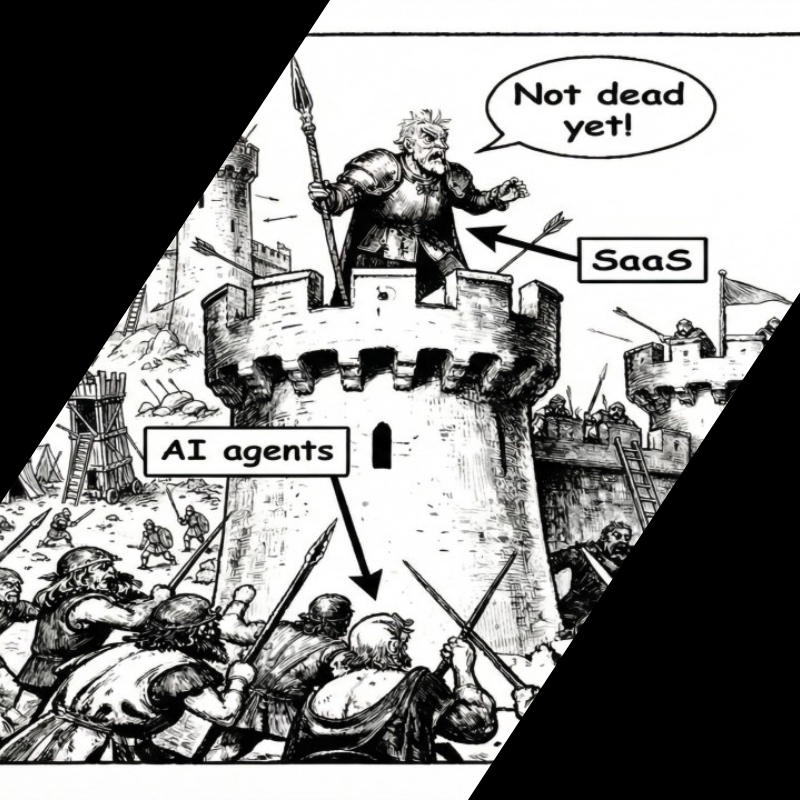
Arguing against them increasingly feels like shouting from the castle ramparts while the barbarian hordes storm the walls.
And yet. The argument that the foundation model providers will not win everywhere still holds for me. Focus and specialization still matter and are dispositive.
But that is no longer the right question.
The new central question is whether vertical AI vendors can win against the rest of the world armed with powerful, general-purpose agents. You can outrun three to five giants, but can you do the same against an army of weaponized customers and developers?
Nicolas Bustamante, the founder of Fintool and co-founder of Doctrine, recently made the case that LLMs are systematically dismantling the moats that once justified vertical software’s premium multiples. If you do not have proprietary data that cannot be scraped or synthesized, regulatory lock-in, or network effects, then general-purpose reasoning agents will eat your lunch. It’s a great synthesis, and every vertical player should take it to heart.
I agree that the best vertical startups will have those moats. But a lot of enterprise software will be bought from startups that do not fit neatly into that framework, and some will be enduring businesses.
Here is why — and the answer has everything to do with where the barbarians actually are.
The Threat Is Inside the Building
The conversation about AI disrupting software usually imagines the threat coming from outside. But the more immediate and chaotic threat comes from inside the enterprise itself. General-purpose agents are now powerful enough that anyone in an organization can build one. A marketing manager spins up an agent that pulls customer data. A junior analyst automates a reporting workflow without anyone reviewing the logic. Three departments independently build agents that interact with the same CRM, creating conflicts no one anticipated.
For an enterprise, this is both beautiful and frightening. For CISOs, CFOs, and Chief Risk Officers, it’s mostly frightening. They will not sign off on a world where hundreds of ungoverned agents run loose across the organization.
And that is exactly why enterprises will buy software — not just to do the work, but to impose the structure, governance, and coherence that makes AI-powered work safe and reliable at organizational scale. The barbarians are not just at the gates. They are inside the building. And that is the problem enterprise software has always existed to solve.
The Answer: Packaging Complexity
Enterprises do not buy features. They buy solutions — and solutions require design, orchestration, governance, security, and accountability. Capability alone is not a deployable enterprise solution.
#1 Design addresses how humans and agents interact. It is paramount yet uncharted territory. SaaS codified enterprise processes into software. But one of the most profound changes coming with AI is that enterprises will move from buying automation to buying outcomes. Those who argue that workflow is dead are directionally correct, but incomplete. In its place, we will need well-designed agentic workflows that manage the handoffs between agents and humans — and those workflows will be reimagined from scratch around outcomes.
It’s early. Most startups are still wedging in with discrete task automation tackling the jobs to be done. That is smart for now and an easier sale to enterprises, but ultimately not enough. The saying “your mess for less” was common in Business Process Outsourcing (BPO) because BPO firms rarely re-designed and improved enterprise processes. Inserting Agent X for this task and Agent Y for that one, but doing the job the same way, will not create long-term winners.
Instead, AI startups need to begin with an outcome-design mindset. Consider commercial lending. A startup thinking in terms of task replacement would first gather all the borrower data, then have an agent automate the financial spreading and wait for a human to review, and finally have an agent create an underwriting memo and wait for a human to edit. A design built around outcomes will take advantage of the 24×7, scalable agent capabilities and create a real-time, iterative conversation with the borrower. Agents could request data as needed to qualify borrowers, show the borrowers how the lender will model their credit worthiness and match them with loan products, and allow the borrower to change variables like loan rate, points, or term. At any point, the borrower could request to speak with a loan officer, and when they do, the agents would prepare the loan officer with notes, recommendations, best next steps, etc. If this saves the loan officer 10 hours per loan, all of that can be spent on relationship building, cross-selling, and ensuring the customer gets the most value from the lender relationship.
Design will be the most durable form of domain advantage. General-purpose agents will probably, eventually learn every domain. An agent can learn the rules of commercial lending or insurance underwriting. But knowing the domain is not the same as knowing how to redesign the work. Designing the right interaction between agents and humans — where to automate, where to hand off, where to keep a human in the loop not for compliance but because it genuinely produces a better outcome — requires the kind of judgment that only comes from deep, sustained focus on a problem space. That’s not a knowledge gap. It’s a design gap.
Get the agent-human interaction design right, and you will have an early advantage that compounds. Reflecting on the birth of ecommerce, Amazon nailed the checkout flow while countless merchants had obtuse, high-friction checkouts. The underlying capability was the same, but Amazon’s design of the end-to-end experience created an early competitive advantage that compounded. Seems obvious now, but it was not at the time.
#2 Orchestration is about how agents work with each other. Any meaningful enterprise process involves multiple agents — one that extracts data, another that analyzes it, another that drafts a communication, another that checks compliance. Someone must decide the architecture: which agents manage the workflow, when to use specialized agents, and when to invoke a skill versus spinning up a separate agent. Think of it like staffing an investment team — you need a leader who knows when to pull in the tax expert, the industry analyst, or outside counsel, in what order, with what context passed along. Knowing the industry vertical and the function is critical to optimizing specialist agents vs. general-purpose agents, pre-built integrations vs. as-needed API calls, and agents vs. humans. All of this will affect cost, reliability, and speed.
#3 Governance means the policies, approvals, and controls that determine who can deploy an agent, what it is allowed to do, what happens when they are duplicative, how decisions are reviewed, and the imposition of security and data requirements. In financial services, a model that generates investment recommendations may need to be validated, documented, and approved before it goes live. Some payments may be initiated by agents; others require human approval. In healthcare, an agent might read the radiology report, and even provide the results, yet not have authority to order prescriptions.
#4 Security in the enterprise is table stakes. It means data isolation, access controls, audit trails, and compliance with industry-specific regulations like HIPAA, SOX, or GDPR. A general-purpose agent can be powerful, but an enterprise buyer needs to know exactly what data it can access, who can see its outputs, and how to prove that to a regulator. Security may not strongly favor vertical software over foundation model providers in all industries, but it can in industries with industry-specific regulations like healthcare, financial services, and public sector.
#5 Accountability means having a throat to choke. When an agent makes an error that costs money or creates risk, enterprises need a vendor who owns the outcome. They need SLAs, incident response, and a product team that understands the domain well enough to diagnose what went wrong. A general-purpose agent does not come with a customer success team that knows your industry.
The companies that package all this together — the design, orchestration, security, governance, and accountability — are building something that a general-purpose agent with plugins simply does not replicate. Packaging complexity is a real and enduring source of value.
Vertical Software Players Can Succeed, But the Race Is On
This case for packaging complexity IS the defense of software, and especially of vertical software that brings domain knowledge to every decision. However, it’s not yet clear how enterprises will buy and deploy all this needed governance, security, and accountability.
Three categories of players are competing for the enterprise AI stack.
Foundation model providers. Anthropic, OpenAI, Google are solidly individual productivity tools today, but the trajectory makes clear they are moving towards this orchestration layer. Anthropic shipped Cowork in January, added plugins two weeks later, then added enterprise connectors, private plugin marketplaces, and admin controls two weeks after that. And the February launch explicitly featured orchestration across Excel and PowerPoint — context flowing between tools, not just a human chatting with an agent. The pace is extraordinary and moving toward the orchestration layer. What keeps them from being the default orchestration layer – risk of model lock-in for one. But some buyers will accept that.
Purpose-built horizontal orchestration platforms. Stack AI, Thread AI, Copilot Studio posit the enterprise wants a single neutral orchestration layer across all business functions: visual workflow builders, multi-agent coordination, governance dashboards, deployment infrastructure. This looks a lot like how enterprises have bought for decades, and frankly it is hard to imagine not having some layer like this because enterprises need to manage complexity across all their functions.
Vertical software vendors — Harvey in legal, Fazeshift in accounts receivable, Abridge in healthcare — these kinds of players own the domain expertise, workflow design, and customer relationship for a specific function. This is the category that needs to change the most and get the packaging right to survive. The best will absorb security, governance, and orchestration into their own products because their customers will demand it.
Realistically, all three will find buyers in the enterprise along lines of size/scale and technical sophistication. JPMorgan will build a lot more software in-house than it did before because the cost of doing so will fall. They will absolutely have their own horizontal orchestration platform. Small and midsize companies like a community bank or domestic manufacturer will buy a lot of individual vertical software products and need orchestration built in.
These are genuinely open architectural questions. What I believe is that vertical vendors are best positioned to solve the hardest part: designing and packaging the domain-specific work that produces outcomes. Whether they build, buy, or integrate the horizontal infrastructure is a strategic question each will answer differently. But domain expertise comes first, and that is not something a horizontal platform or foundation model can easily replicate.
Conclusion
Making the case for vertical startups may look crazy right now. That’s fine. The foundation model providers are building governance, orchestration, and enterprise packaging at remarkable speed, and the window for startups is not infinite. But the high-probability scenario is that the greatest problem to be solved is the hard, domain-specific work of designing how agents and humans should interact, how agents work with each other, and how all of it operates safely within the constraints of a real enterprise. That work favors the focused over the general. The opportunity is decades long, but the window to establish yourself is right now.